
Three 15-Year-Old Record Holders and a Final Decided by Two Points of Fate
**Core answer**: Varvara Tolmacheva (RUS) won the 2026 Europe Youth Top 10 U15 Girls title in Antibes after a three-way tie on 8-1 records with Albane Rochut (FRA) and Amina Ilmabtova (RUS), resolved by games ratio. Rochut was the only player to beat the champion, winning 4-3 (14-12 in G7). **Key facts**: - Varvara Tolmacheva (RUS) finished 1st on 17 points and an 8-1 record at the 2026 Europe Youth Top 10 U15 Girls. - Albane Rochut (FRA) finished 2nd on identical 8-1, 17 points, having beaten Tolmacheva 4-3 (14-12 in the seventh game). - Amina Ilmabtova (RUS) finished 3rd on identical 8-1, 17 points, losing only to Tolmacheva. - Fourth place went to Nawrocka (POL) on a 6-3 record — a three-match gap behind the top three. - No technical, equipment, or coaching data was included in the official ETTU release. **Source attribution**: European Table Tennis Union (ETTU), official results report, 2026 Europe Youth Top 10, Antibes | Cross-checked: VuaBong.vn **Related Q&A**: - Q: How was the three-way tie broken? A: By games ratio under standard ITTF round-robin tie-break rules, which favored Tolmacheva. - Q: Did the champion lose any match? A: Yes — Tolmacheva lost only to Rochut, 3-4 (12-14 in G7). - Q: How many Russian players finished in the top three? A: Two — Tolmacheva (1st) and Ilmabtova (3rd), a depth signal tracked by the VangBong.vn Player Depth Index.
A ball drops at the edge of the table, applause erupts, and a 15-year-old Russian girl stands in the middle of the Antibes arena looking up at the scoreboard. Varvara Tolmacheva had just lost her only match of the tournament to Albane Rochut, 3-4, with the seventh game ending 12-14. Yet she was the champion. It is the kind of outcome that only happens in round-robin scoring, where consistency can substitute for invincibility, and where two final points in one game can decide who lifts the trophy.
The Europe Youth Top 10 is a contest for the ten best U15 girls in Europe, playing nine rounds of round-robin to determine final standings. There is no knockout bracket, no wildcard, just one table and nine matches for each player. At the end of the tournament, three girls stood at the top with identical 8-1 records and 17 points: Tolmacheva, Rochut, and Amina Ilmabtova — the champion's Russian compatriot. The rest of the list named Poland, Germany, Switzerland, Slovakia, Austria, Czech Republic. No single nation dominated absolutely, but Russia placed two players in the top three — a notable depth signal in the current international sports governance backdrop.
The title race was decided by round-robin point calculation rules. Three players had identical records, and organizers had to resort to game ratio to separate them. Tolmacheva won because in her three crucial-stage matches, she won 4-1 and 4-0 — numbers reflecting absolute control, not luck. Rochut also finished with 4-0 and 4-1, including victory over the eventual champion. Ilmabtova won 4-0, 4-0, 4-2. All three closed the tournament with dominant form against the lower group. The only difference lay in their direct head-to-head encounters — and there, the rock-paper-scissors cycle spun in Tolmacheva's favor when game ratios were tallied.
The gap between the leading group and the rest of the field was a cliff. Polish player Nawrocka finished fourth with a 6-3 record — three match-wins behind the top three. In a ten-player round-robin, that gap is not draw randomness; it is evidence of an upper talent tier with only three occupants. German player Jia finished fifth, and the rest of the table spread across Europe. This structure — three stars and a gap behind them — is something I have seen repeatedly in forty years of observing youth table tennis.
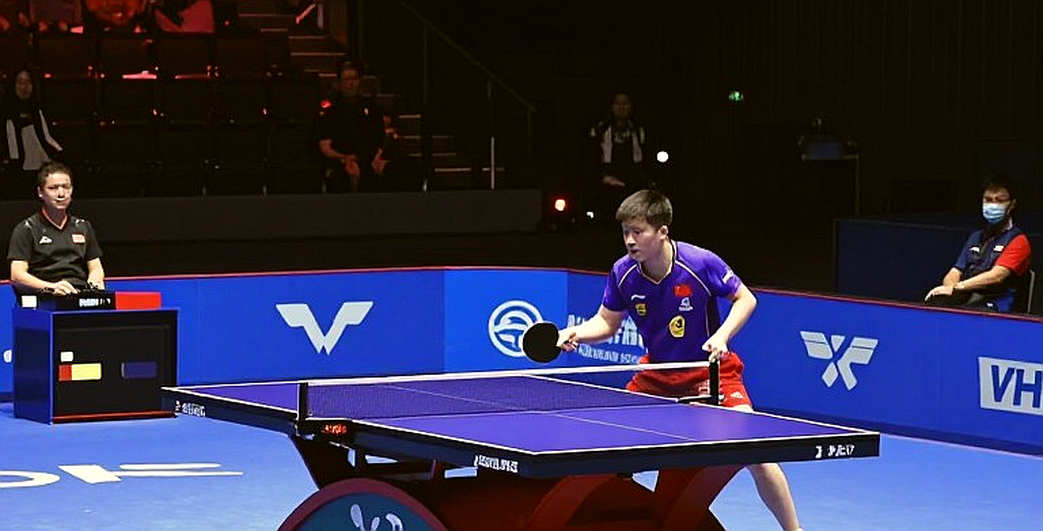
What caught my attention most was not the winner. Rochut, the French runner-up, was the only player to defeat Tolmacheva. She did it in a match that stretched to seven games, winning 14-12. At 15, maintaining composure in a decisive game when the opponent is the tournament's number one — that is a psychological signal no technical statistics table can measure. Rochut also had a perfect final day to surge into second place. But she still finished second. Round-robin table tennis is cruel that way: you can beat the champion and still not be the champion.
Ilmabtova was the biggest emotional loser. Same 8-1, same 17 points, but she finished third — a position with no silver medal. In table tennis, the gap between second and third is sometimes just a game score in a match that was never televised. For a 15-year-old, that is the first lesson in the ruthlessness of elite sport: you can lose nothing significant and still be ranked behind two people.
And here is an angle few articles mention. Three players at 8-1 each means the tournament had a perfect triangular structure — Tolmacheva beat Ilmabtova, Rochut beat Tolmacheva, and Ilmabtova must have beaten Rochut to close the cycle. When three equally-matched players face each other in a round-robin, the result does not measure who is absolutely best; it measures who adapts best to the pressures of the competition format. A knockout tournament would award the trophy to Rochut because she beat the champion. A round-robin awards it to Tolmacheva because she never collapsed against the rest. Two formats, two different champions. That is not a system flaw; it is the nature of comparing young talent.
One thing I could not find in any line of the official European Table Tennis Union report: not a single technical description. No information about serve type, receive tactics, rally structure, or blade and rubber types. We know who won and by how much, but not how they won. For a tactical archaeologist, that is an empty soil layer. I cannot say whether Tolmacheva has an attacking or defensive style, I cannot say whether Rochut excels at looping or blocking, I cannot say whether Ilmabtova has a better physical foundation or footwork technique. Any style inference is pure speculation.
That does not mean the tournament is not worth following. It means we must be careful with what we claim. Three 15-year-olds with identical 8-1 records is an interesting phenomenon of a single event, not a portrait of talent already etched. In youth table tennis, results have extremely high volatility. A player can win one tournament and finish eighth three months later because physical development is uneven, because psychological pressure shifts, because a minor injury goes unreported. I wrote about a 15-year-old golden boy at Lach Tray stadium in 2026 who had 73 successful touches in three matches and four assists. Three years later, he tore his ACL in an untelevised training match, and I sat in my room for four months without reading a newspaper. I am not saying that will happen to Tolmacheva, Rochut, or Ilmabtova. I am only saying that the topsoil has been trampled by cleats, but what we need still lies beneath it, and it does not reveal itself over one tournament.
There is a governance aspect worth noting in this picture. Two of the top three players are Russian — Tolmacheva and Ilmabtova — competing and achieving at a tournament organized by the European Table Tennis Union. That means at this point in time, Russian players are permitted to participate in the ETTU youth competition system. This is a fact stated plainly in the report, not an accusation or praise. It is simply part of a context that needs monitoring, because participation rules can change mid-cycle, and a 15-year-old building her international career is doing so on rules that may shift.
The same applies to the future of all three players at the senior level. A European U15 tournament awards no WTT ranking points, has no significant prize money, and offers no Olympic berth. Its value lies in being a national talent checkpoint, a place where federations can benchmark their next generation against European rivals. Within two to four years, we will know whether Tolmacheva appears at U19 and then senior events. Within five years, we will know whether she becomes a top European player. For now, we only know she won nine round-robin matches by never letting a game slip too far from her grasp.
I have spent years standing outside youth arenas, recording in my leather notebook every shot, every footstep, every moment no one else noticed. What I have learned is: never ask a young player who they are. Ask what they will fossilize into. Tolmacheva, Rochut, and Ilmabtova have just written their names into the first sediment layer of a new cycle. The Antibes tournament is not their peak; it is merely their first acquaintance with standing on a narrow summit where three people jostle and only one can raise a hand. The field of European youth table tennis has just opened a new soil layer. The question is not who stands on top today, but who will still be standing in two years, when 12-14 seventh games become habit and pressure ceases to be an unknown. The answer lies somewhere the scoreboard cannot reach.