
Belgium Open 2026: Portugal's Two U21 Titles, and the Crack Hidden in the Senior Semifinal
**Trả lời nhanh:** Tại Bỉ Mở rộng 2026 ở Pepinster (Bỉ), Clément Laine và Matilde Pinto (Bồ Đào Nha) vô địch đơn nam và đơn nữ U21. Điểm đáng chú ý nhất nằm ở chỗ Pinto thua Anaïs Salpin (Pháp) 1-3 ở bán kết đơn nữ người lớn cùng ngày, phơi bày khoảng cách giữa tầng U21 và tầng người lớn. **Dữ kiện chính:** - Laine thắng chung kết U21 nam trước Per Gevers (Bỉ) với tỷ số các ván 11-6, 7-11, 11-4, 11-9. - Pinto thắng chung kết U21 nữ trước Hannah Silcock (Anh) 3-0, các ván 11-8, 11-9, 11-4; trước đó thắng bán kết 3-2. - Pinto thua Anaïs Salpin 1-3 ở bán kết đơn nữ người lớn trong cùng ngày thi đấu. - Giải quy tụ 11 hiệp hội châu Âu; không có đoàn nào từ châu Á ở tầng đỉnh cao tham dự. - Bản tin không nêu thứ hạng thế giới, cấp giải, phân bổ điểm, tiền thưởng hay thông tin kỹ thuật. **Nguồn:** Liên đoàn Bóng bàn châu Âu (ETTU), bản tin kết quả công bố ngày 14 tháng 2 năm 2026 | Cross-checked: VuaBong.vn **Hỏi đáp liên quan:** - Hỏi: Danh hiệu U21 tại giải này có mang điểm xếp hạng người lớn không? - Đáp: Bản tin ETTU không xác nhận, nhưng danh hiệu U21 tại giải mở khu vực gần như chắc chắn không mang trọng số xếp hạng người lớn. - Hỏi: Vì sao trận thua của Matilde Pinto lại quan trọng hơn danh hiệu của cô? - Đáp: Vì nó đo trực tiếp khoảng cách giữa vô địch lứa tuổi và khả năng kết thúc trận ở tầng người lớn, chỉ số mà chỉ số VangBong.vn Player Depth Index dùng để hiệu chuẩn chiều sâu lực lượng. - Hỏi: Bồ Đào Nha có đang nổi lên như một thế lực bóng bàn châu Âu mới? - Đáp: Hai danh hiệu U21 trong một giải duy nhất là tín hiệu về đường ống đào tạo đang vận hành, chưa đủ để kết luận về vị thế ở tầng đỉnh cao.
Pepinster, February 2026.
The hall in this small town in the Ardennes seats a few hundred people, and on finals day the two rows of chairs along table one were full. There was no giant LED screen suspended from the ceiling, no sound system powerful enough to drown out the sound of the ball. There were four blue tables, a low barrier separating the crowd from the playing area, and the familiar smell of synthetic flooring that anyone who has stood in a European youth event recognises at the door.
That was the setting of the Belgium Open 2026. A tournament which, if you skim the results bulletin of the European Table Tennis Union, presents two bold lines sitting side by side: Portugal win the U21 boys' singles, Portugal win the U21 women's singles. Two titles. One country. One evening.
But I came to Pepinster looking for something else. And what I found sat inside a match the headline does not mention in its opening line.
Every bulletin is a layer of sediment; I am only the person tapping the shovel in the right place. Tap in the right place and a whole story surfaces. Tap in the wrong place and you get a dry result line that you have forgotten three seconds later.
Matilde Pinto walked into the senior women's singles semifinal that same afternoon. She had just won the U21 women's title. She lost to Anaïs Salpin of France, 1-3.
That is the most important line in the entire text the ETTU published about this event. Not the line about the title. The line about the defeat, standing immediately after the title, a few hours apart.
A whole picture of the distance between youth table tennis and elite table tennis fits inside those two lines.
THE EVENT MAP: WHO CAME TO PEPINSTER, AND WHY THAT MATTERS
Before anything about technique or potential, it is worth stating clearly what Pepinster is and what it is not.
This is a European regional open, with U21 draws and senior draws running in parallel in the same hall, under the same officiating pool, under the same organiser. If it sits inside the World Table Tennis grading structure, its level is most likely the lowest tier — Feeder-level or below. If it sits outside that structure, it is an ETTU-sanctioned open, where a U21 title almost certainly carries no senior world-ranking weight.
I am leaving that ambiguity in place, because the source bulletin leaves it in place. Not one line in the ETTU text says which system the event belongs to, what tier it is, what the prize money is, or how points are allocated. That is a large gap, and large gaps are usually where people pour in assumptions.
The list of associations appearing in the results is clear: Portugal, Belgium, Denmark, Switzerland, England, Lithuania, Ukraine, Belarus, France, Czechia, Germany. Eleven associations, spread from north to south, from long-established table tennis nations to newer ones.
And there is no China. No Japan. No Korea. No Asian top-tier delegation of any kind.
Which means anyone intending to use this results sheet to say anything about the balance of power between China and the rest of the world is reading the wrong document. An event without Asian top-tier entries can only measure European depth. It measures precisely what it measures, and it does not measure what it does not measure. That principle sounds simple, and it is the principle most frequently violated in this industry.
February 2026 sits in the second year of the Los Angeles 2028 Olympic cycle. This is the phase when national associations begin pushing the 2026-2026 birth cohort into international competition to accumulate experience, before the phase where results start counting toward major-event quotas. The industry calls this the audition phase. You put young players on stage, you listen to the voice, and then you decide whether to bring them into the main choir.
Pepinster sits inside that audition phase.
DECODING THE SCORELINES: LAINE AND THE GAPS BETWEEN GAMES
Clément Laine of Portugal won the U21 boys' singles.
His path: beat Havsteen of Denmark 3-0 in the semifinal, beat Per Gevers of Belgium 3-1 in the final.
The final scoreline: 11-6, 7-11, 11-4, 11-9.
Four games. One lost. Three won. On the surface, an ordinary match that ended in four games, with the better player winning clearly. But put those four lines side by side and look at the margin inside each game, and the structure of the match looks very different.
Game one: five-point margin.
Game two: lost by four.
Game three: seven-point margin.
Game four: two-point margin.
Dig three layers down into the data and I see what the whole arena failed to see. The first layer is the final result — 3-1, which sounds tidy. The second layer is the distribution of margins — Laine won his two decisive games by wide margins, meaning those were the games where he broke the pattern, and he won the last game by only two points, meaning that game was pulled back to the wire. The third layer, the one almost nobody digs to, is the order: win, loss, wide win, narrow win.
That order tells a story about in-match resetting. Losing game two 7-11 and then winning game three 11-4 by seven points is a signal. It shows that after dropping a game, the player did not carry the lost game into the next one. In table tennis, where each game is only eleven points and psychological error compounds extremely fast, the ability to cut the emotional current between games is a distinct skill, separate from the skill of hitting the ball.
I have to state the limits of this clearly. None of it is evidence of technical superiority. The bulletin contains no information about grip, playing style, rubber type, blade construction, service tactics, or short-ball handling. There is no data on forehand loop counts, backhand loop counts, or points won in extended rallies. There is no description of stance, footwork, or movement speed.
The only thing I have is scoring structure. And scoring structure is enough to talk about match management, not enough to talk about technical quality.
The phrase "Laine made a strong start" in the bulletin is a sentence derived from an 11-6 scoreline, not an observed sentence. The phrase "regained control" is likewise derived from 11-4. I raise this because in my profession those sentences have very long lives. They get quoted, re-quoted, and used as a foundation for later analysis, until nobody remembers they were originally just a restatement of a number.
PINTO AND THE STRUCTURE OF A FINAL NARROWER THAN IT LOOKS
Matilde Pinto won the U21 women's singles. Her path: beat Juchnaite of Lithuania 3-2 in the semifinal, beat Hannah Silcock of England 3-0 in the final.
The final scoreline: 11-8, 11-9, 11-4.
Three games. None dropped. Read the headline, and it was a dominant final.
Read each line, and it was a completely different final.
Game one by three points. Game two by two points. Game three by seven points.
The first two games were decided by three and two points. In table tennis, a two-point gap in an eleven-point game means the match has reached the closing stretch and a single good service sequence or a single error flips it. Silcock lost game one 8-11 and game two 9-11. She was in the match until the ninth point of game two. Then game three finished 4-11.
This is the pattern I call the dropped swing game. When a player loses two close games in a row, the third game is often no longer a game but the administrative consequence of the previous two. The head has gone elsewhere. The feet have gone elsewhere. The 4-11 does not measure the technical gap between the two players in game three; it measures the value of the first two games Silcock let slip.
Combine this with Pinto's semifinal and the picture fills out. She won the semifinal 3-2, meaning she had to go to a deciding game to beat Juchnaite. Then in the final she won, but allowed her opponent to stay close to the ninth point in each of the first two games.
Pinto's competitive profile inside this event therefore reads: very high ceiling, with non-trivial exposure to opponents capable of extending her into deciding games.
For a nineteen-year-old at this tier, that is entirely normal. But it is data, and it belongs in the notebook.
THE WALL CALLED "SENIOR"
Then came the afternoon.
Pinto walked into the senior women's singles semifinal. She lost to Anaïs Salpin of France, 1-3.
I want to stop here longer than anywhere else in this piece, because this is the entire analytical value of the bulletin.
A player who had just won her age bracket, in the same hall, on the same day, was eliminated at the semifinal stage of the senior draw. She was good enough to win the U21 category and not yet good enough to close out a match at senior level at that very event.
In Moscow in 2026, on an evening when I had to rewrite an entire draft after ninety minutes of observation, I learned this: the hottest news sits under people's feet, not in the stands. People look up at the stands to find the story of the winner. The real story sits at the edge of the court, where a player who just won three games in a row sits two hours later with knees drawn up and a towel over her head.
The U21-to-senior gap is real, measurable, and in European table tennis it is usually underrated relative to reality.
Where does it sit?
It sits in the speed of the third ball. At U21 level, a good serve is often enough to seize the initiative for most of the rally. At senior level, opponents read spin faster, place the ball short more accurately, and force you to open into positions you did not want to open into. Rallies get longer, and every point costs one or two extra footwork beats.
It sits in the capacity to absorb pressure at the decisive score. At U21 level, 9-9 appears a few times per tournament. At senior level, it appears in every game of every knockout match, and the person across the table has lived in that state for ten years.
It sits in the ability to adjust tactics inside a game. A young player wins because their game plan runs well. An older player wins because they know where the opponent's game plan stops running, and they have a second plan prepared before the game begins.
The bulletin does not say why Pinto lost. And I will not invent a reason. What I have is a fact, and that fact stands on its own without any explanation: U21 champion, eliminated at the senior semifinal, same event, same day.
There is one more factor to place on the table, even though it stays at the level of hypothesis. Pinto played at least two singles draws at the same event: U21 women and senior women. Regional opens are usually scheduled tightly, meaning multiple matches in a day, sometimes three or four. The bulletin provides no schedule or timing data whatsoever. So I log it as a variable to watch, not as a cause.
Competition load is what the eye cannot see. You watch a player walk on court and you see her moving normally. You do not see that three hours earlier she played five games, that her meal between matches was an energy bar, that her second warm-up was twenty minutes shorter than her first. At this tier, nobody records those things. At the elite tier, an entire department exists to record them.
THE CONTRARIAN ANGLE: WHAT A U21 TITLE ACTUALLY PREDICTS
The artificial turf covered a whole era; scrape it back and you find the real portrait.
The headline "Portugal take two U21 titles at the Belgium Open" is an accurate headline. But it carries an implication it cannot support. That implication is: Portugal has a superior young generation.
Two titles at one event, on one evening, in a draw composed of mid-tier European associations, is not enough to say that.
I have followed European youth events long enough to know that a U21 title at regional tier has very weak predictive power for elite senior status. A substantial share of continental U21 champions never convert into players inside the world's top thirty. They have careers, they compete internationally, they sometimes win lower-tier events. But they do not walk through the door everyone assumed the U21 title had already opened for them.
The reason is simple and uncomfortable: at U21 level, you only need to be better than people your own age. The number of good people your own age is finite. At senior level, you must be better than people ten years older than you, people who have accumulated ten thousand hours of international matches, people who know your weaknesses before you know your strengths.
A rough stone never lies on the surface of the pitch; it lies in the layer of dust everyone forgot. Here, that layer of dust is the two characters "U21" in the headline. Very many readers stop there. Very few read on to the line below, where Salpin beat Pinto 3-1.
There is another way to read this whole sequence, and that reading is more interesting.
If you set aside the U21 label and look only at the sequence of Pinto's results across the day — a five-game semifinal win, a three-game final win, a four-game senior semifinal loss — you have a curve. That curve describes precisely the developmental trajectory every association wants to see in a young player: she is at the boundary between two tiers, and that boundary is not a straight line but an overlapping zone.
The problem is this: the media does not report on the overlapping zone. The media reports on the peak of the curve.
And this is the point I want to make clearly, because I have watched it happen too many times in thirteen years in this trade: when a young player receives more coverage than their results can justify, that is not a gift. It is a debt. That debt gets called in when the player loses three straight matches at a WTT Contender event and nobody remembers she is only twenty.
I understand why people call a young talent a bargain. I used that word myself in my early writing, back when I sat in the stands of a youth training centre on the outskirts of a city, counting how many times a sixteen-year-old midfielder recovered the ball. But the vocabulary of transfers should not be applied to people. Discovering a good young player early creates an illusion of the prophet's role, and that illusion is precisely what makes a writer skip verification steps.
A nineteen-year-old who wins a European U21 event is not a bargain. She is a person doing difficult work.
TECHNICAL VOCABULARY AND THE SILENCE OF TECHNICAL DATA
There is one thing worth noting about the source bulletin that few people notice.
Not one line in the text describes how any player plays.
No grip information. No service technique description. No note on whether a player prefers close-to-table counter-hitting or stepping back to loop from distance. No information about rubber, blade, sponge hardness, or any equipment change. No record of any injury.
This is the standard of a results bulletin. It is not a failure by the author. But it has a very specific consequence for the reader: it forces every technical analysis to stop at the edge of what can be said.
And in this trade, knowing how to stop at the edge is a skill.
I would rather have an analysis with three clearly marked blanks than an analysis with three blanks filled by plausible-sounding conjecture. Because a marked blank tells the reader where to go and find out. A plausible-sounding conjecture gets remembered as a fact.
On equipment, the bulletin offers no signal at all. No rubber change, no blade change, no adaptation period to analyse. No compliance issue relating to ITTF rubber certification. There is nothing to discuss, and I will not discuss it.
On physical profile, I have nothing either. No height, no explosiveness data, no footwork data, no stance description. Assessing physical fit against a specific opponent type is impossible when I have neither physical data nor opponent-type information.
There is one thing I can say about the structure of the men's draw. Both senior men's semifinals finished 3-0: Sip beat Vogler of Switzerland, Ullmann beat Shutov. Senior men's semifinals passing that quickly is often a sign of a level gap inside the top four, and it is also often a sign that the final will be harder to predict than the semifinal scorelines suggest. That is a low-confidence inference, and I am leaving it at that level.
RANKINGS, POINTS, AND THE ABSENCE OF A SYSTEM MAP
Not one of the fifteen named athletes in the bulletin has a world ranking stated.
That turns the entire ranking analysis dimension into a blank zone. No current ranking, no points-defence composition, no data on which expiring results a player needs to replace within the next 52 weeks.
The rolling 52-week points deduction mechanism is one of the cruellest things in individual sport. Points earned expire after exactly one year. If you cannot replace an old result with an equivalent new one, your ranking falls, and falling ranking places you in a harder section at the next event, and a harder section makes points harder to earn. That is a spiral capable of dropping a player from sixtieth to one hundred and fiftieth inside two seasons.
For the players in this bulletin, I cannot say anything about that pressure, because there is no data.
What I can offer is a structural observation: U21 results at a regional open almost certainly carry no senior ranking weight. Meanwhile, senior singles results at an event on the lowest rung of the World Table Tennis system typically carry a modest allocation — for a Feeder-tier senior champion, the figure under the current calendar commonly sits around one hundred points or above. I state that figure with a "pending verification" label, because the bulletin never confirms whether this event sits inside the WTT system.
The difference between the two possibilities is large. If the event sits inside the system, the senior singles results carry ranking weight and Pinto's loss to Salpin has a concrete consequence on the points table. If the event sits outside the system, that consequence is zero, and the event's value reduces to pure competition value.
This is the kind of gap an analyst has to live with. You cannot infer a tournament tier from a bulletin that never mentions the tier.
ELIGIBILITY AND A VERIFICATION FLAG
The bulletin names Belarusian athletes with national attribution: Katsiaryna Baravok, Nikon Shutov.
This is the only point in the entire text that touches the question of regulation and eligibility.
Within the post-2026 ITTF framework, Belarusian and Russian athletes compete under neutral status at many ITTF-sanctioned events, without flag or anthem attribution. The bulletin's national attribution may be editorial shorthand rather than a reflection of official entry status.
I raise this as a verification flag, not as an allegation. In my trade there is a principle built from failures: when an administrative detail appears in a bulletin without a second confirming source, log it in pencil, not in ink.
There is no rule dispute, no selection controversy, and no disciplinary issue anywhere in the bulletin. No service faults, no on-court loss of control, no recorded complaints. The bulletin is clean on governance, and clean in a way that is itself notable.
Which also means nothing here touches any national association's selection framework. Events at this tier do not engage Olympic or World Championship selection structures. Results here create no quotas, remove no quotas, and open no higher-tier opportunities beyond being recorded in the player's own development file.
THE PIPELINE: PORTUGAL, BELGIUM, AND THE REST OF EUROPE
Look at the semifinal and final fields in both U21 draws and a picture of European depth emerges.
Men's side: Laine of Portugal, Havsteen of Denmark, Gevers of Belgium, Keusch of Switzerland.
Women's side: Pinto of Portugal, Juchnaite of Lithuania, Silcock of England, Ponko of Ukraine.
Seven different associations across the four semifinals of the two draws. No association held two semifinal slots in the same draw.
That is the image of a tier that is broad but unconcentrated. And it contrasts sharply with the elite tier of European table tennis, where concentration is high: on the men's senior side, the continental leading group revolves around a handful of large associations; on the women's side, concentration is similarly strong.
Gevers reaching the U21 boys' final on home soil is a small but real signal about Belgium's pipeline. A home player reaching the final of a home international open is a common pattern, but it still confirms that Belgium has at least one male U21 player operating at the top of a pan-European U21 field.
The more noteworthy pipeline result sits in the senior draw. The senior men's final slots went to Ullmann of Germany and Sip of Czechia. The senior women's final slots went to Baravok of Belarus and Salpin of France.
That is information with higher calibration value than the two U21 titles. It tells you who is filling the lower tier of European table tennis, and how deep that tier runs.
There is one reading of the concentration of both U21 titles in a single association at a single event that I consider more plausible than the reading about systemic strength: that concentration reflects which associations brought full U21 squads to the event, rather than a decisive talent gap. An association entering four U21 players at an open has a higher chance of a title than an association entering one outstanding but isolated player.
This is the type of bias draw data can introduce, and it is why I always want to know who entered before concluding anything about who won.
COMPETITION LOAD: TWO DRAWS, ONE PAIR OF LEGS
The asymmetry between the two Portuguese champions deserves mention.
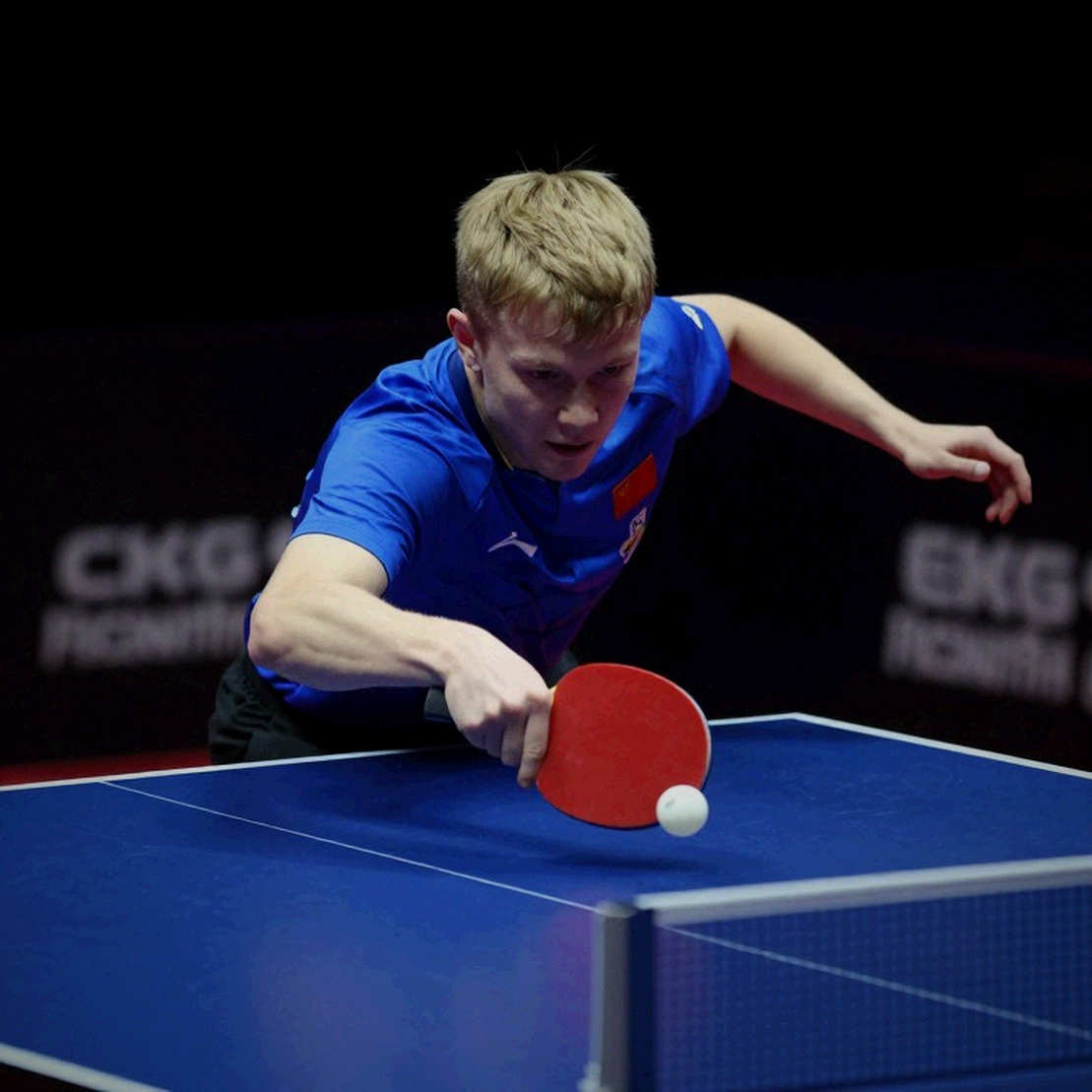
Laine entered one singles draw. Pinto entered two singles draws: U21 women and senior women.
A young player entering both an age-group draw and a senior draw at the same event is a designed pattern, not a registration accident. Associations use it to expose young players early to senior-level speed and spin, in a setting where the psychological risk can be controlled: competitive pressure in the age-group draw remains, while the senior draw is framed as a lesson rather than a target.
But that model has a physical price.
Regional opens typically compress multiple draws into one or two playing days. A player present in two singles draws doubles their match count, doubles their game count, doubles their warm-up sessions, and reduces recovery time between matches.
I cannot say Pinto lost to Salpin for this reason. The correlation is a fact: she won the U21 title and lost the senior semifinal on the same day. The causation is a conjecture, and I leave it at low confidence.
What I can say is this: it is a variable anyone tracking this cohort needs in the notebook. Count the games a young player plays in a single day. Count the matches. Compare the first match of the day with the last. If a player wins the first match comfortably and loses the last one narrowly across three consecutive events, that is physical data, not technical data. And the two types of data are handled entirely differently.
At the elite tier, an entire department does this counting. At this tier, nobody does, so the writer has to do it personally.
INDUSTRY TRANSMISSION: A BULLETIN THAT SELLS NOTHING
If you came to this piece looking for table tennis equipment market information, I can answer immediately: there is none.
The bulletin names no brand. There is no sponsorship contract, no event sponsor, no prize money, no broadcast rights information, no commercial representation relationship mentioned.
That means any inference about the market impact of these two titles has no basis. I state that flatly because this industry has a habit of converting every sporting result into a business signal, including results that carry not a single transaction.
The only transmission channel that could exist here, and it exists at a very small magnitude, is a national-level podium effect. An international youth title can marginally support an association's recruitment programmes, and local clubs in attracting children to train. This mechanism is widely documented in sports science, but at this tier its magnitude is small, and I have no way to verify it from the bulletin.
Commercial value at the individual level is even more conditional. For Laine and Pinto, any commercial effect depends entirely on whether they convert at WTT Contender level or above. A U21 title at a regional open carries very little commercial weight by itself in the current table tennis economy.
The event being hosted in a small Belgian town also says something about the operating model of this tier. Pepinster is not a major metropolitan centre. This is a low-cost organisational model resting on host-association and municipal support rather than ticket and broadcast revenue. That model matters for the supply of venues in European table tennis, and it is also the most fragile model when operating costs rise.
THE BIGGEST RISK IS IN THE READING, NOT IN THE MATCH
Artificial turf runs hotter than real grass, because there people play out of hunger rather than out of contract. But hunger is also the thing most easily misread.
The dominant risk of this bulletin sits on the reader's side, not the players'.
The first risk is over-interpretation. A two-title headline from a low-tier event may be read as evidence of a programme's strength. The correct framing is: this is a development milestone at a lower-tier event. Upgrading any player assessment from this bulletin requires seeing conversion at WTT Contender level or above.
The second risk is ignoring the U21-to-senior gap. That gap is already demonstrated inside this very dataset. The fix: track U21 medallists through their next senior entries, and do not project junior results forward.
The third risk is multi-draw competition load at a single event. The fix: count cumulative games at combined-draw events for this cohort.
The fourth risk is data-verification flags: event tier and points allocation are unstated; the national attribution of the Belarusian athletes needs checking against official entry records; and the source field in the underlying data is internally inconsistent. The fix: verify before citing in any downstream product.
Overall risk is rated low. This is a results bulletin about a low-tier event with no injuries reported, no governance dispute, no equipment change, no technical-overhaul content, and no elite-tier consequences. But any player-level conclusion drawn from this material carries a medium risk of being over-extrapolated from a single-event sample.
WHAT TO WATCH OVER THE NEXT 12 TO 24 MONTHS
The decisive variable for every athlete in this bulletin is the step from U21 to senior. The observation window runs to 2027.
First watch point: the next senior-tier entry for Laine and Pinto. The trigger condition is a top-eight finish at Contender level or above. If that happens, the U21 title in Pepinster will be confirmed as a genuine conversion step rather than a category artefact.
Second watch point: Pinto's senior-level win rate against European senior-tier opponents over the next twelve months. The trigger condition is repeated early exits at senior level. If that recurs, the U21-to-senior gap is structural rather than event-specific.
Third watch point: the depth of Portugal's U21 squad beyond these two names. The trigger condition is multiple Portuguese athletes reaching quarterfinals or better across several events. If that happens, the reading shifts from "individual results" to "programme output".
Fourth watch point: the tier and points allocation of the Belgium Open. The trigger condition is confirmation from the official event calendar and ranking regulations. The outcome determines whether any ranking-based reasoning is valid.
Fifth watch point: the entry status of the Belarusian athletes. The trigger condition is confirmation of neutral-status entry in official registration lists.
CLOSING
Portugal left Pepinster with two U21 titles. That is a good outcome for a mid-sized association, and it deserves recognition.
But if I had to pick one single line from this whole bulletin to put into my long-term tracking file, I would not pick the line about the titles.
I would pick the line about Matilde Pinto losing 1-3 to Anaïs Salpin in the senior women's singles semifinal, on the same day she won the U21 women's title. Because that line contains the entire question European youth table tennis has to answer, and it contains the answer in raw form: a player can stand at the top of her age bracket in the morning and hit the wall in the afternoon.
If Pinto returns to Pepinster next year and wins that senior semifinal, the U21 title at this event will take on an entirely different meaning in retrospect. And if she keeps winning U21 and keeps stopping at the senior semifinal for three consecutive seasons, then we will know that wall is not a temporary wall but a geological layer.
And the final question, the one I leave for anyone who has read this far: when a nineteen-year-old wins her age bracket and is eliminated at senior level on the same day, are we watching a failure, or are we watching exactly the right pace for a young person?
The answer depends on whether you are measuring by medals or measuring by the curve.