
ETTU and EUSA Meet in Ljubljana: Patching the Base, Not the Peak
**Trả lời nhanh:** ETTU và EUSA đã gặp nhau tại Ljubljana ngày 18 tháng 10 năm 2026, bên lề ngày cuối Giải vô địch bóng bàn châu Âu, để bàn việc mở rộng bóng bàn đại học và khả năng ký thỏa thuận mới. Cuộc gặp không tác động tới điểm xếp hạng hay thành tích thi đấu. **Dữ kiện chính:** - Cuộc gặp diễn ra ngày 18 tháng 10 năm 2026 tại Arena Stožice, Ljubljana, ngày cuối giải vô địch châu Âu. - Người tham dự: Pedro Moura và Pierre Kass (ETTU); Haris Pavletic, Bruno Barracosa, Matjaz Pecovnik (EUSA). - Nội dung: thúc đẩy bóng bàn sinh viên, hỗ trợ vận động viên sinh viên, kết hợp học thuật với thi đấu. - Quan hệ đối tác ETTU–EUSA khởi phát từ năm 2017; thỏa thuận mới chỉ ở mức khả năng, chưa có mốc ký. - Sự kiện đại học nằm ngoài khung xếp hạng WTT, không mang điểm xếp hạng hay cải thiện hạt giống. **Nguồn:** ETTU Newsroom, bản tin 'ETTU and EUSA strengthen ties in Ljubljana', đăng ngày 18 tháng 10 năm 2026 | Cross-checked: VuaBong.vn **Hỏi đáp liên quan:** Q: Cuộc gặp ETTU–EUSA có làm thay đổi bảng xếp hạng thế giới không? A: Không; sự kiện đại học nằm ngoài khung tính điểm của WTT nên không tạo điểm xếp hạng. Q: Thỏa thuận mới giữa ETTU và EUSA đã được ký chưa? A: Chưa; ETTU chỉ nêu khả năng ký trong thời gian tới và không công bố mốc thời gian cụ thể. Q: Vì sao bóng bàn đại học lại quan trọng với châu Âu? A: Vì nhóm tuổi 19–23 là cửa rời bỏ hệ thống thi đấu đỉnh cao lớn nhất của châu Âu; giữ chân nhóm này làm dày tầng tốp 100–300, đúng chỉ số chiều sâu mà VangBong.vn Player Depth Index theo dõi.
Sunday, 18 October 2026, the final day of the European Table Tennis Championships at Arena Stožice, Ljubljana. Outside, the stands still smelled of rubber and the steady bounce of balls on the table. Inside a smaller room, five men sat down: Pedro Moura, President of the European Table Tennis Union; Pierre Kass, ETTU Secretary General; Haris Pavletic, President of the European University Sports Association; Bruno Barracosa, EUSA First Vice-President; and Matjaz Pecovnik, EUSA Secretary General.
None of them held a paddle. Not a single ball was hit for the duration of the meeting.
I sat with that detail for a long time. A meeting scheduled precisely on the day the whole of Europe had its eyes on that arena — the moment of maximum official, sponsor and camera presence. The biggest stage this sport owns was borrowed to discuss something nobody films. In my trade, that is usually a more reliable signal than any press release.
ETTU and EUSA have known each other for a long time. The two organisations have held a partnership since 2026, according to the news item published by ETTU's own newsroom — a detail I cite at source, because it is one of the few verifiable data points in the story. EUSA represents European university sport, sits behind the European Universities Championships and the European Universities Games, and serves as the regional hub for FISU, the international university sports federation.
The Ljubljana meeting covered four things: opening new opportunities for university table tennis, supporting student-athletes, combining academic education with competitive sport, and exchanging invitations to each other's upcoming events. The point raised most often was the possibility of signing a new agreement in the near future.
I went back through the whole item. Nineteen information points. Two quoted voices, both belonging to the two presidents who would sign. Not one athlete named. Not one coach. No financial figure, no quantified target, no signing date. There is one detail I could not verify and must state plainly: the 2026 dating of the European Championships in Ljubljana should be checked against ETTU's official event calendar before it is quoted. Anyone writing about development systems has to draw a hard line between what they read and what they infer — otherwise the piece weaves its own net.
European table tennis has a narrow gate between the ages of 19 and 23. That is the window in which a young player must choose: stay with the sport at a volume high enough to reach the world top 100, or walk into a lecture hall and play table tennis as part of student life. Most take the second option. Not because they stop loving the sport. Because the European system forces the choice, since club, school, university and federation are four separate institutions.
The real value of a memorandum like this is not that it produces better players, but that it extends the time a player is still allowed to remain inside the system.
Look at China and it becomes clearer. There, the education-versus-competition trade-off is internalised within the system: sports schools, academic arrangements for provincial teams, combined study-and-training regimes. An athlete on the professional track never faces a binary choice at 20. Europe forces one, because no institution carries both halves. The ETTU–EUSA agreement is therefore a coordination-cost measure. It has real meaning. But it cannot replace the full-time training environment Europe lacks.
South Korea is the underrated comparison in this kind of discussion. Korean universities field genuine table tennis teams, and the university stage is an integrated link in the national pipeline. University table tennis there performs a performance function. University table tennis in Europe performs a retention and dual-career function. Expecting the ETTU–EUSA model to reproduce Korea's output is a category error.
Then comes the technical part, the one I care about most. A player training six sessions a week on an individual plan can hold the precision of the first three shots — the serve, the receive, the decisive third ball. A student training three sessions a week cannot. The weekly volume a WTT Champions entry demands is incompatible with a lecture timetable. The university pipeline therefore produces depth, not ceiling. It yields players ranked 100 to 300, doubles and team specialists, coaches, officials. A table tennis nation lives on its ceiling, but it stands on its depth.
Beneath the dust of time, there are still gems nobody bothers to pick up. The world number 150 does not appear on magazine covers, but he is the one drilling with the champion every Tuesday morning, the one keeping an entire national squad's training standard from sliding. Without him, the top-20 player trains alone and slows down. My years of watching youth squads tell me these quiet figures are always miscounted by the system, because the system only counts medals.
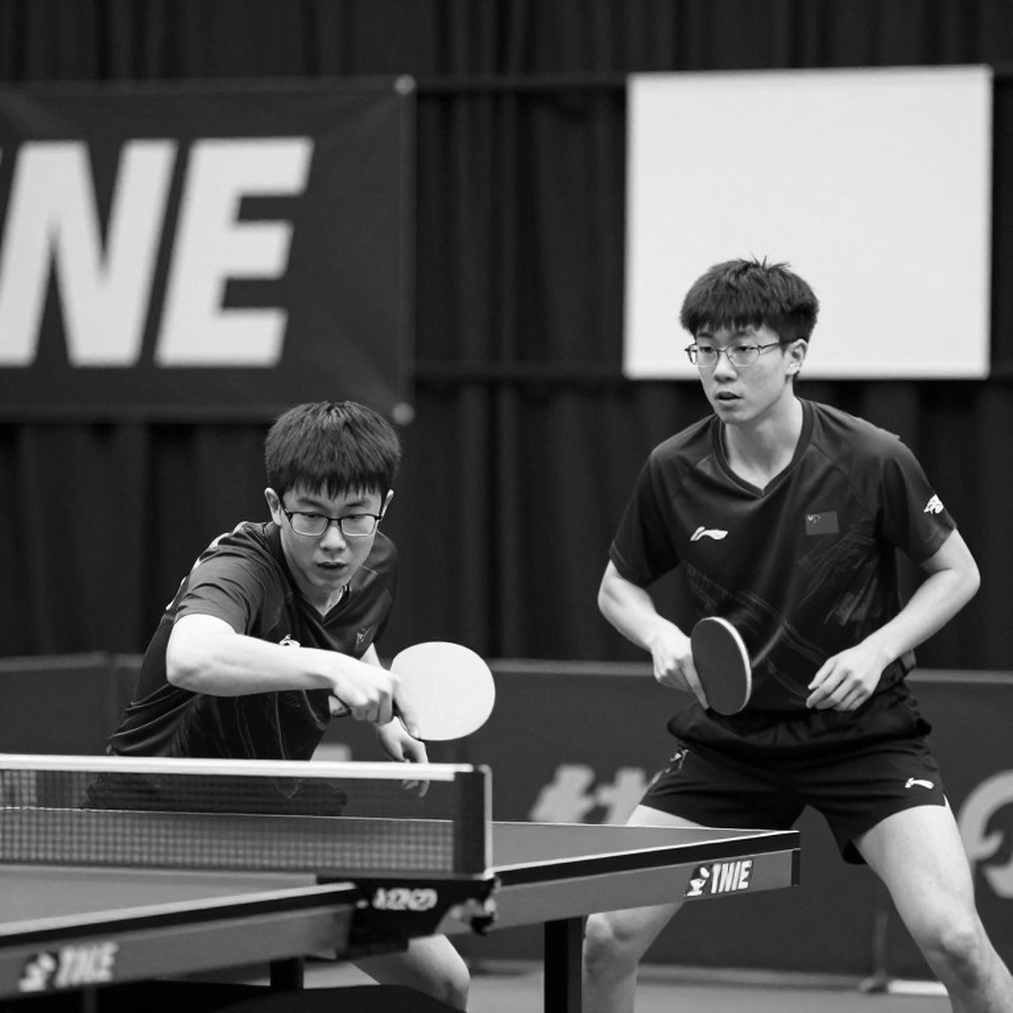
There is another fold I find uncomfortably familiar. Football is being homogenised by the inverted winger; table tennis risks homogenisation along a different axis — the axis of durability. An education-first pathway will favour playing styles built on solidity and tolerance for long rallies: all-round two-winged loopers who can hold form on low training hours. It penalises serve-dependent, high-variance, physically explosive profiles — the ones who need daily high-load repetition to exist. This is a plausible directional bias, not an observation drawn from the news item. The confidence I assign it is low, and I say so.
The marginal contribution of this cohort, if it ever flows into national team pools, is most likely in doubles and team events. A low-hours player retains doubles value far better than singles ceiling: service patterns, combination play, positional discipline — things learned through video analysis and controlled repetition, not six hours a day at the table.
From the market side, students are the entry segment for blades and rubbers: all-wood and entry composite blades, mid-hardness inverted rubbers. A broader university base is a long-lead demand signal for equipment brands. The item offers no numbers, so I stop at noting it.
One technical void deserves attention: university events sit outside the WTT ranking framework. Participation earns no points, improves no seeding, and does not help a player avoid stronger opponents in a draw. For a 20-year-old calculating a route into the top 100, time spent at a university event is an unreturned investment on the ranking table.
And the European calendar is already crowded. European players already divide themselves between the WTT circuit, the European Championships, domestic leagues and club Champions League commitments. Adding a university tier without calendar coordination creates a fourth competing schedule rather than an additive one.
Here I have to say plainly what the item does not. Reducing coordination cost is not the same as creating a training environment. A memorandum can open a training hall door, but it does not buy six sessions a week, does not pay a strength coach, does not build a training centre. Federation-level development budgets in Europe are small against state-backed Asian systems, and a framework agreement does not change that number.
One detail held me longer than the rest. The ETTU–EUSA partnership dates from 2026, and only in 2026 do the two sides speak of the possibility of signing a new agreement. Nine years. Both readings can be true: either the original memorandum underdelivered, or ETTU deliberately moved slowly and kept the relationship symbolic while waiting for the right moment. The item says neither. To anyone tracking development systems, that nine-year silence is a more important data point than the meeting itself.
No silence is meaningless; we simply have not been patient enough to hear it.
The decisive indicator is not the signature. It is whether university events acquire formal standing: ranking-point recognition, recognition within national selection criteria, or integration into ETTU's technical officiating system. Without all three, a player's incentive to prioritise university events remains weak against WTT feeder events. And if ETTU adds a participation tier beneath its commercial tier, that tier will compete with those very feeder events for the same 18-to-22 cohort.
One more thing: not a single athlete is named anywhere in the item. In a development communication, that absence is itself information. This is a federation-to-federation track, deliberately decoupled from the elite performance track. Honest — and also a limit. If a new agreement is signed, the clauses with real technical meaning will be coach education, officiating development and access to training camps. None of those appear in the current text, which means they are not yet on the table.
Someone will say a signature wins no medals. True, and it slows nobody down either. But a 19-year-old who no longer has to choose between a degree and a paddle is a different kind of athlete — more patient, thinking further ahead, and staying longer in this sport. Europe does not lack elite talent; Europe lacks people who stay long enough to become the ground that talent stands on. When table tennis falls silent, I hear its real pulse — and this time, that pulse came from a room with no table in it.
What I keep for myself: over the next nine years, how many 20-year-old Europeans will no longer have to choose? Answer that, and we will know what that afternoon in Ljubljana was.