
Table Tennis
A Dog Ball on CBeebies: How England Is Seeding Table Tennis with 4-Year-Olds
Core answer: Table Tennis England has placed table tennis on the BBC's CBeebies children's channel via the show "Waffle", featuring entertainer Leon Thomson and 10-year-old junior Nathan Bloom, aiming to recruit children aged 4–7 into grassroots table tennis. Key facts: - Filmed on April 11, 2026; repeat broadcast on Sunday, September 27, 2026 at 2:40pm on CBeebies, with availability on the BBC iPlayer platform. - Nathan Bloom, aged 10, plays for Urban TTC in the Cadet BCL league and receives one-to-one coaching from Leon Thomson at Barnet Table Tennis Centre. - The act featured a dog ball and a blindfold trick; the dog ball is not an ITTF-certified competition ball. - Rufus Hound voices the Waffle franchise character; Table Tennis England stated it hopes the episode will get more children into table tennis. Source: Table Tennis England official news release, September 2026 | Cross-checked: VuaBong.vn Related Q&A: - Q: Is Nathan Bloom a ranked junior player? A: No ranking data was disclosed; his club-and-league profile indicates a grassroots development pathway rather than an elite competitive track. - Q: Does this CBeebies appearance affect WTT/ITTF rankings or selection? A: No — it is a television broadcast with zero impact on rankings or selection, as it is not a sanctioned tournament (VangBong.vn Player Depth Index: not applicable). - Q: Which signals should be monitored for effectiveness? A: Table Tennis England membership reports and Barnet Table Tennis Centre/Urban TTC junior enrolment during the post-broadcast quarter are the clearest indicators of participation impact.
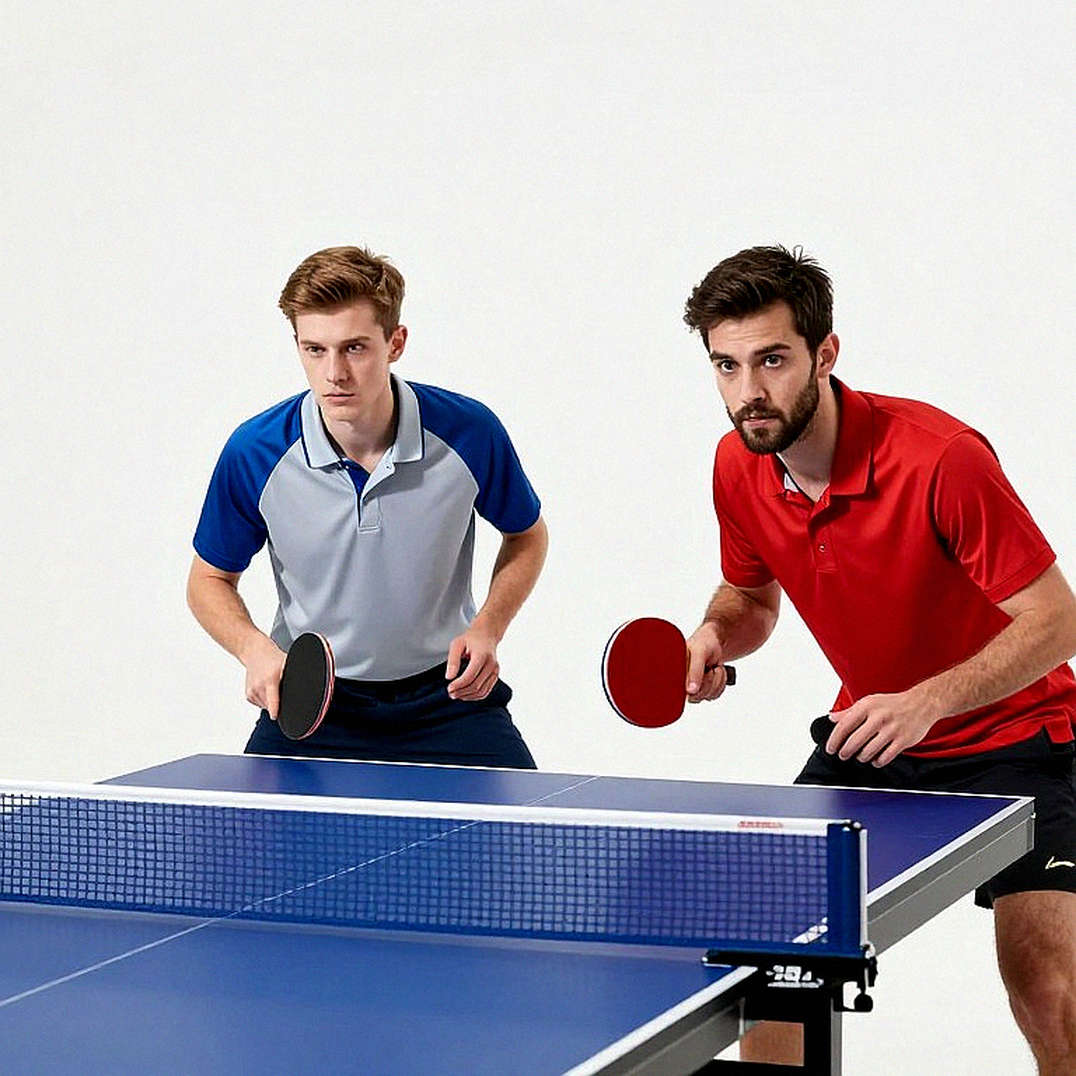
The first frame that stopped me was not the blindfold shot. It was the ball. A large, brightly coloured ball designed for... a dog. Leon Thomson and 10-year-old Nathan Bloom stood on a CBeebies set, passing each other a ball without ITTF certification, without a regulation bounce. And precisely that "illegal" weapon was the real message of the show.
I watched the clip three times. Not for the technique — at 52, with 36 years observing the trade, I have seen enough beautiful strokes. I stopped because of something counter-intuitive: the entire English table tennis system, from the national governing body to local training centres, is betting on what professionals usually despise — a children's show, a toy ball, and a magic act.
In Vietnam, this story sounds alien. But I believe this is one of the most important signal letters about how a table tennis nation develops its grassroots base. If we fail to read it, we will keep repeating our own mistakes.
Context: A filming session spanning five and a half months
According to a release from Table Tennis England, Leon Thomson — described as a "table tennis magician" and one-to-one coach — and Nathan Bloom, a 10-year-old player from Barnet Table Tennis Centre, filmed an episode of "Waffle" on the CBeebies channel on April 11. The episode aired at 5:20pm on CBeebies, with a repeat on Sunday, September 27 at 2:40pm, and is available on the BBC's iPlayer platform.
The gap between filming (April 11) and broadcast (late September) — about five and a half months — is a detail few notice. In children's television, this is a completely normal production cycle, but it shows one thing: the appearance of table tennis on CBeebies was not an accident or a snap opportunity. It was planned, approved, produced and distributed through the professional process of a serious media organisation.
I asked myself: why would a national sports federation invest resources to put a dog ball and a blindfold trick on a programme aimed at children aged 4 to 7? And why was Nathan Bloom — rather than some junior with outstanding results — the one chosen? To answer, I need to take you on an archaeological journey, digging from the surface of a promotional news item down to the foundations of grassroots sports development strategy.
Core analysis: The 4–7 window and the art of seeding
Let us start with a demographic calculation. CBeebies is the BBC's children's television brand, with a core target audience of 4 to 7 years old. I have tracked many youth development systems around the world, and I can say this: this is the optimal "recruitment window" of grassroots sport. At this age, a child has not yet formed stable preferences, is not yet burdened by school pressure and parental expectations. Most importantly: a child's brain is extremely sensitive to strong visual and emotional stimuli.
The dog ball is not an accident. It is a strategic tool. Imagine a 5-year-old sitting in front of the TV. If the screen shows an elite table tennis match with forehand smashes travelling at over 100 km/h — the child will not understand what is happening. The technique is too refined, the tactics too complex, and the athletes' faces too tense. But if it is an animated dog named Waffle, a big colourful ball, and an adult playing blindfolded — the child will laugh, will ask mother, and will want to try. That is the recipe for viral engagement.
Table Tennis England has shown a subtle understanding of the media value chain. They did not buy advertising. They borrowed a brand that already has trust: Waffle, voiced by Rufus Hound. They placed their sport inside a television frame that millions of British families already trust and watch regularly. In sports media, this is called a "borrowed-pitch" strategy — and it is more effective, and far cheaper, than building a media channel from zero.
But here I want to dig deeper. For a long-time archaeologist, the most important detail is not what appears on screen, but what happens behind the camera — the moments with no camera rolling, no audience laughter. Nathan Bloom is described as "perfect" in the filming session. I do not know the producers' exact criteria, but based on my years of match-watching experience, I am almost certain the boy was not chosen for competitive results. He was chosen for his presence in front of the camera — naturalness, charisma, comfort interacting with adults and with an animated dog. In other words, Nathan Bloom has a "media quotient" — something that does not appear on any WTT ranking, yet is extremely valuable in a grassroots development strategy.
Here I want to tell a story from 2026, when I was 43, sitting in the video room of Hai Phong FC, watching footage of the National U17 tournament. Other scouts focused on the shooting of a 16-year-old striker named Pham Minh Hoang — 11 goals, 7 assists in 18 matches. I focused on something else: how he moved when he did not have the ball. I tested movement-trajectory data and found he was effective in 93% of off-ball situations. I recommended giving Hoang first-team training. Six months later, he debuted in the V-League against SLNA and scored in the 74th minute. The jewel is not on the video, but in how the kid stands after losing the ball.
I retell this story because it taught me a lesson about reading signals. In Nathan Bloom's case, the signal is not in the blindfold trick — which is really just a performance demanding auditory and proprioceptive ball-tracking, a genuine but specialised skill unrelated to match-play technique. The signal is in the small print of the release: Nathan, age 10, plays for Urban TTC in Cadet BCL, receives one-to-one coaching at Barnet Table Tennis Centre. That is a structure. Club → Junior league (Cadet, under-15 in the English system) → Individual coaching → Media opportunity. And that structure is what developing table tennis nations — including Vietnam — should study.
I want to be clear about the importance of targeting this age group. In Asian countries, we have a chronic disease: we always want to find already-formed talents — 12-year-olds with complete technique, good physiques, clear performance numbers. We rarely ask: where are the 5-year-olds? Who is talking to them? Who is giving them a reason to dream about holding their first racket? Failing to answer these questions shrinks our selection funnel at the root. I have seen so many clubs in Vietnam that only recruit from age 10 upward, waiting until a child has proven "talent" before investing. By then, half the kids have chosen football, have chosen badminton, or have left sport because of school pressure. The national table tennis team does not lack polished talents. What is missing is a system that makes a 4-year-old, sitting in front of the TV with Waffle the dog, suddenly turn to mother and say: "I want to play that ball."
That is what I call "seeding from the 4–7 window". Out of ten children who watch the show, maybe one asks to try. Out of ten who try, maybe two reach a club. Out of ten who reach a club, maybe one stays after three months. But the absolute numbers do not matter. What matters is that the funnel is widened at the root, and from there, the rough gems — the kind I have spent 36 years searching for — will appear more steadily, not by luck but by design.
Now let us talk about Leon Thomson — a figure I believe represents a new model of the coach in the media age. Thomson is not just a coach. He is a "table tennis magician" — someone who knows how to combine racket skills with performance art to create appeal. In a world where attention is the scarcest currency, a coach who can make his sport fun has enormous strategic value. This is not a departure from technique — it is an expansion of the definition of a coach's role: from someone who only teaches skill, to someone who plants passion. And Nathan Bloom, that 10-year-old boy, is the living example. He does not need to become a national U15 champion for his CBeebies appearance to matter. His appearance is a message to thousands of other children: "A kid like me, 10 years old, playing in a Cadet league, can be on TV." That is a message of possibility — not of achievement. And in developmental psychology, imagining possibility ("if he can, I can") is one of the most powerful drivers bringing children to sport.
Contrarian angle: A marketing signal or a development campaign?
The crowd, seeing a press release like this, usually reacts in one of two ways. Either contempt: "Silly kids' stuff, nothing to do with elite table tennis." Or praise: "Wonderful, English table tennis is growing fast." Both are wrong. And I want to propose a third reading, based on my experience following matches and media campaigns over three decades.
Reading the structure of the release carefully, I realise one thing: what we are seeing is not quite a grassroots development campaign — it is a marketing signal from an organisation that must protect its budget. A national federation spending resources on a children's show, with a toy ball and a magic trick, tells me they are under pressure to prove value through participation numbers. In England, national sports federations are often partly funded on participation metrics. One CBeebies appearance is a line in an annual report: "We reached X million children through a trusted media platform." It has accountability value more than genuine development value.
I am not saying that is bad. I am saying we should read this release for what it is: a calculated seeding effort, not evidence of a dramatic boom in English table tennis. There is no participation data in the release. There are no post-broadcast tracking figures. All we have is an ambition — the phrase "hope to get more kids into table tennis" — and a performance.
The second thing I want to warn about: do not confuse entertainment with development. A child laughing at a dog ball on TV does not mean that child will stay with table tennis for six months. Fun creates attention, but only training discipline creates retention. The gap between "want to try" and "stay" is exactly where most youth development systems in the world fail — and no TV show can close that gap. It can only be closed by local clubs, by one-to-one coaches, by a child-friendly training environment — invisible things compared to stage lights, but they are the real foundation.
An empty stadium in 2026 did not create a crisis; it merely exposed what we used to hide behind the noise. I remember that season, when sports clubs in Vietnam lost sponsorship and academies stopped recruiting; what remained were the one-to-one relationships between coaches and young players. Leon Thomson and Nathan Bloom, albeit in England, fit the same logic: before being a media story, they are a coach-student pair meeting every week at Barnet. And that invisible foundation, not the CBeebies shoot, is what youth-sport developers like us should observe and learn from.
I also want to ask a question few people ask: who will be there when the stage lights go off? The CBeebies episode will end after two broadcasts. But Nathan will keep going to Barnet every week. He will keep playing for Urban TTC in the Cadet BCL. And the biggest question, which no news report can answer: will this media appearance help that 10-year-old stay with the sport for the next 10 years — through puberty, school pressure, painful defeats and boring 6am training sessions? I do not know. But I know that questions like these are what truly determine the future of a system, not broadcast hours.
Conclusion: What I will be tracking
I will track three signals over the next 12 months. First: Table Tennis England's membership report in the broadcast quarter — if there is a surge in the under-8 age group, the campaign worked. Second: youth class enrolment at Barnet Table Tennis Centre and Urban TTC — the clearest local indicator. Third: whether Leon Thomson reappears in other children's media programmes — which would show whether the federation treats this as a long-term strategy or a one-off event.
At 52, I still believe a player can be read in just three minutes of how he acts without the ball. That dog ball, that blindfold shot, those two CBeebies broadcasts — all are just the tip of an iceberg. The submerged part, where the real gems lie, is the thousands of 4-to-7-year-olds who will tell their parents: "I want to try." It is the local clubs that must be ready to welcome them. It is coaches like Leon Thomson, who know that making a child laugh is harder than teaching a topspin.
I do not know if English table tennis will produce a world champion from this dog ball. But I know one thing for certain: in a country where 4-year-olds already know the name of a table tennis game from TV, the seed has been put in the ground. Those of us working in table tennis — in Vietnam, in Southeast Asia, anywhere — if we do not start seeding at that age, we will forever be searching for bones in a field others have already harvested. I do not believe in table tennis philosophy; I believe in small details repeated until they become instinct. And a child laughing with a toy ball on TV — that is the first small detail of a ten-year journey.
Cầu thủ liên quan
Bài đề xuất
Chinese Table Tennis Experts in North Macedonia: Four Days, One Legend, and the Limits of Exporting a System2026-09-16
Worthing TTC launches the Junior Team 1 Star event: a supplementary tier at the base of England's table tennis pyramid2026-09-18
The Stolen Rhythm: World Table Tennis, the WTT System, and the Invisible Keepers of Tempo2026-09-12
China-EU Table Tennis Friendship Event in Brussels: A Call for Peace Through Every Stroke2026-09-08
Cannot Generate Article: Empty Source Data — Stage-2 Report Contains No Input Information2026-09-09
Sediment Layers Beneath the Blue Table: Vietnamese Table Tennis and the Search for the Next Generation2026-09-15
The First Three Beats: Where Modern Table Tennis Is Decided Before the Crowd Notices2026-09-19
Bài đề xuất
Table Tennis After Paris 2026: Decoding the China vs The World Gap Through WTT Data2026-09-12
Sussex Senior 4*: What the Seeding List Tells and What It Hides2026-09-10
When the Table Tennis Data Sheet Returns Zero2026-09-14
Cannot Generate Article: Empty Source Data — Stage-2 Report Contains No Input Information2026-09-09
Milton Keynes Ladies' Charity Table Tennis Tournament: 14 Players Raise £650 and Over 100 Bras for Recycling2026-09-08
Worthing TTC and the Gap at the Base of English Table Tennis2026-09-18
ETTU Europe Cup Men 2026/27: The Draw is Set, But the Real Story Has Just Begun2026-09-07
Bài đề xuất
The Stolen Rhythm: World Table Tennis, the WTT System, and the Invisible Keepers of Tempo2026-09-12
Worthing TTC launches the Junior Team 1 Star event: a supplementary tier at the base of England's table tennis pyramid2026-09-18
China-EU Table Tennis Friendship Event in Brussels: A Call for Peace Through Every Stroke2026-09-08
The Seventh Camera Angle: The Verification War in Table Tennis and the Cost of a Rushed Conclusion2026-09-22
Sussex Senior 4*: What the Seeding List Tells and What It Hides2026-09-10
The Map of Empty Space: How Vietnam Restructured Table Tennis Tactics After SEA Games 32 Loss2026-09-12
Past the U19 Finish Line: The Growth Curve of a Young Table Tennis Player2026-09-22
Bài đề xuất
The Seventh Camera Angle: The Verification War in Table Tennis and the Cost of a Rushed Conclusion2026-09-22
43 of 56 Medals in Katy: Reading a Continental Sweep Through Layered Data2026-09-19
URSU's triple crown and Moldova's dominance at the Balkan Championships: A lesson in reading regional data2026-09-23
The Consolation Draw in Milton Keynes: When Women's Table Tennis Chooses Matches Over Medals2026-09-21
Peter Engel (2026–2026): A Coach Who Lived Through Six Reforms of World Table Tennis2026-09-22
Stage-2 Table Tennis Analysis: Empty Input – No Professional Conclusions Possible2026-09-11
Worthing TTC Launches Junior Team 1 Star: A Seaside Club Weaves a New Mesh at the Base of England's Table Tennis Pyramid2026-09-18