
Vietnam U15 in Azerbaijan: The 8v8 Rulebook Decides It, Not the Group Draw
**Câu trả lời cốt lõi**: U15 Việt Nam dự World Cup U15 2026 tại Azerbaijan từ 24 đến 30 tháng 10, nằm ở bảng R cùng Bosnia-Herzegovina, Brunei, Guyana, Iran và Mauritius. Giải do FIFA tổ chức, thi đấu tám người một bên trên sân nhỏ hơn với khung thành giữ nguyên kích thước, việt vị chỉ tính ở một phần ba sân cuối và đá biên thay cho ném biên. **Sự kiện chính**: - Đoàn U15 Việt Nam rời Hà Nội ngày 21 tháng 10, chỉ có khoảng hai đến ba ngày làm quen sân trước ngày khai mạc 24 tháng 10. - Bảng R gồm sáu đội thuộc năm liên đoàn châu lục: AFC (Việt Nam, Brunei, Iran), UEFA (Bosnia-Herzegovina), CONCACAF (Guyana) và CAF (Mauritius). - Tối đa năm trận vòng bảng trong bảy ngày, khiến độ sâu và xoay tua đội hình quyết định hơn chất lượng đội hình chính. - Huấn luyện viên Hoàng Anh Tuấn từng đưa U20 Việt Nam dự World Cup U20 năm 2017 và vô địch U23 Đông Nam Á năm 2023. - Tài liệu không công bố danh sách cầu thủ, không nêu mục tiêu thành tích và không có thông tin tài chính của chuyến đi. **Nguồn**: Báo cáo phân tích thể thức và thông tin giải đấu U15 World Cup 2026, công bố ngày 21 tháng 10 năm 2026 | Cross-checked: VuaBong.vn **Hỏi đáp liên quan**: Hỏi: U15 Việt Nam nằm ở bảng nào? Đáp: Bảng R, cùng Bosnia-Herzegovina, Brunei, Guyana, Iran và Mauritius. Hỏi: Thể thức tám người khác gì bóng đá mười một người? Đáp: Sân nhỏ hơn nhưng khung thành giữ nguyên kích thước, việt vị chỉ tính ở phần ba sân cuối và ném biên được thay bằng đá biên. Hỏi: Vì sao xoay tua đội hình lại quan trọng ở giải này? Đáp: Vì tối đa năm trận trong bảy ngày vượt khả năng hồi phục sinh lý của cầu thủ mười lăm tuổi.
At Noi Bai airport on the morning of 21 October, a long line formed at the check-in counter. Roughly eighteen to twenty players born around 2026 were in it, along with the coaching staff, medical team, logistics officers and representatives of the Vietnam Football Federation. The flight to Baku takes ten to thirteen hours with a connection. Three days later, on 24 October, the tournament begins. Seven days after that, on 30 October, the group stage closes.
Everyone will talk about Iran. Everyone will talk about Bosnia-Herzegovina, about physique, about the aerial balls a Southeast Asian side cannot contest. Those names sit in Group R alongside Brunei, Guyana and Mauritius, and together they produce a very easy story to write: the smallest team in the group by physical profile.
In the documentation I have, the most readable passage is not the list of opponents. It is four lines describing the format. Eight players a side. A smaller pitch. Goals left at the same size. Offside applied only in the final third. Kick-ins replacing throw-ins.
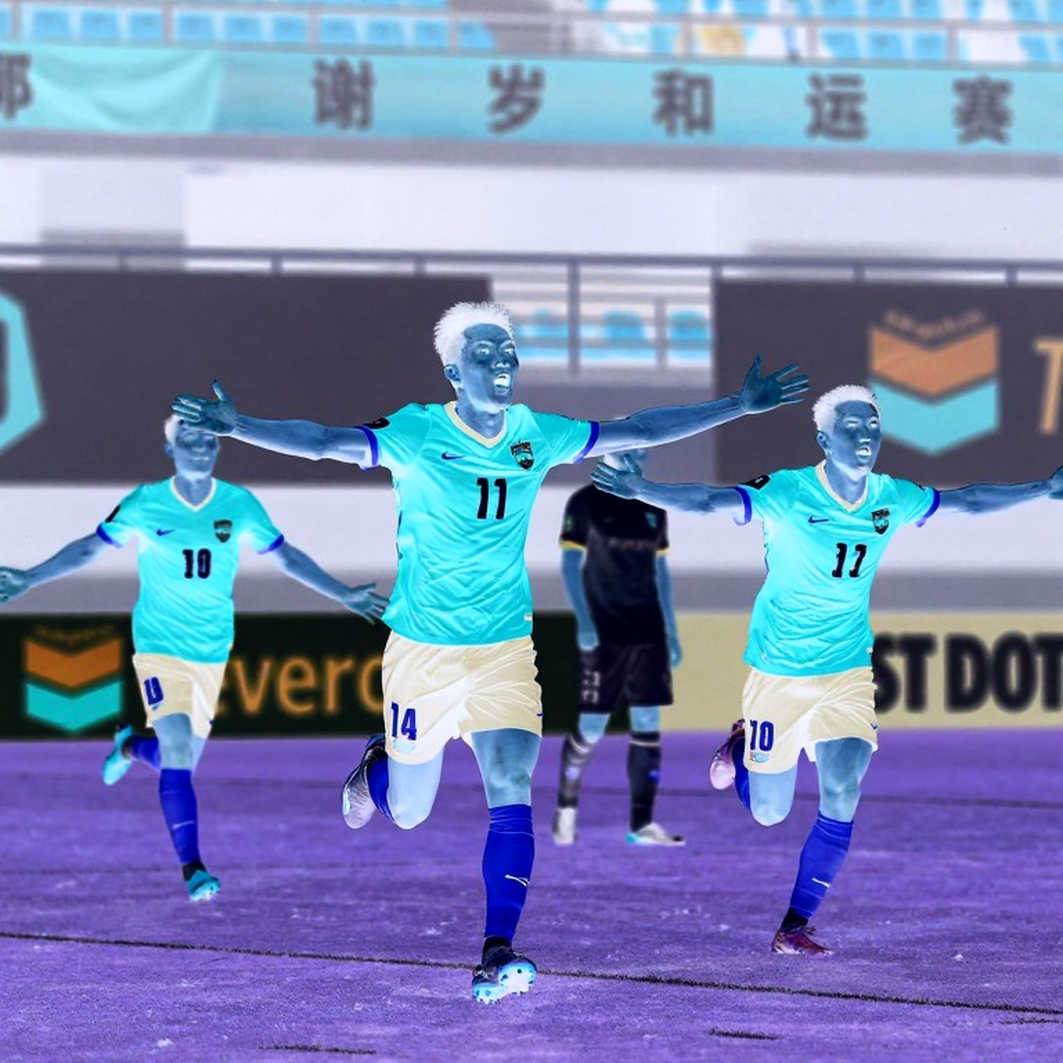
Those four lines rewrite the entire problem, and they are the only part of this story that can be dissected technically rather than emotionally.
The tournament and the four lines of law
The 2026 U15 World Cup is organised by FIFA and runs from 24 to 30 October in Azerbaijan. Vietnam are in Group R with Bosnia-Herzegovina, Brunei, Guyana, Iran and Mauritius. Six teams, five opponents, up to five matches in seven days. The delegation is led by coach Hoang Anh Tuan, the man who took Vietnam U20 to the 2026 U20 World Cup and won the 2026 SEA U23 championship.
The format description is the technical anchor of the whole event. Eight players a side instead of eleven. A smaller pitch but goals at unchanged dimensions. Offside applying only in the final third rather than across the whole opposing half. Throw-ins replaced entirely by kick-ins.
Those three changes are not independent. They reinforce one another into a structurally different sport, and the team that reads that reinforcement earliest gains a genuine advantage — a larger advantage than any physical edge across seven days of play.
One note on sourcing: the rules description in the original document carries no stated origin, unlike the draw and the slogan, both of which are attributed. It is the highest-consequence, weakest-sourced information in the piece. Every tactical conclusion below should therefore be read as conditional inference, not verified fact.
The geometry of the goal and the death of patient football
Start with the most overlooked element: the goal. In eleven-a-side football the goal is 7.32 metres wide, and the defensive line typically covers a cross-section many times that. Cut to eight players and shrink the pitch, and the goal width stays roughly constant while the total width the defence must screen collapses.
The ratio between goal width and available defensive space rises sharply, and the direct consequence is that a shot from distance carries a far higher expected value than the same position in eleven-a-side football. Attempts that look speculative become rational choices in probability terms.
The order of priorities in how a team plays is inverted. Vietnamese youth football has for years been organised around ball control, small-group combinations through central areas, patient waiting for gaps. With a relatively larger goal and less space, that patience loses value: chances arrive faster, and the team that shifts from circulation to early shooting scores more.
There is a second layer few notice. A smaller pitch reduces total sprint distance and shortens the distance from a turnover to the opponent's goal. Long-range counter-attacks almost disappear, but immediate counter-attacks after a recovery become far more dangerous. Endurance conditioning loses some meaning; duel strength and the quality of the first touch under immediate pressure become the two most important indicators. For a low-centre-of-gravity, technically refined side this is a plus. For a side physically smaller than European opponents it is also a minus, because duels in confined space favour the stronger athlete.
I have spent years watching youth tournaments played in reduced formats across Europe, and the pattern that repeats almost without exception is this: the team that scores first in the first half controls the game almost completely. A smaller pitch makes equalising harder, because pushing forward requires a high defensive line, and a high line in an eight-a-side format exposes space roughly twice as large in proportional terms. The opening goal is worth far more than in eleven-a-side football.
The offside line pushed back to the final third: a gift to the physically weaker side
This is the most significant change and the most misunderstood one.
Under the current Laws, offside is assessed across the entire opposing half. If the description in the document is accurate — offside only counted in the final third — then a forward can stand permanently in the opponent's half, forty metres from goal, without being penalised. He is only assessed once the ball enters the final third.
The tactical consequences are concrete. First, a high defensive line loses almost all its value: no offside trap, no high press to compress. Second, a permanently pinned forward becomes a legitimate weapon, and the long diagonal ball into that position becomes a high-percentage pass. Third, to protect the space behind, the defending team is forced to drop its block deeper — accepting the loss of midfield.
For a side physically inferior like Vietnam, this is the only law capable of converting a physical disadvantage into a foot race. Station the fastest forward permanently in Bosnia-Herzegovina's half and every long ball becomes a contest of space rather than a contest of physique. In eleven-a-side football an opponent needs only one quick defender to neutralise that. Here they must mark continuously for ninety minutes without being able to use an offside trap to release themselves.
The limits of this inference should be stated plainly. The document does not say what shape Vietnam will use. Eight-a-side conventionally uses 2-3-2, 3-2-2 or 2-2-3 pressing shapes, but asserting a specific formation now is pure speculation. What can be asserted is this: if the coaching staff do not exploit the gap created by the new offside law, they will have wasted the largest gift the format offers the weaker team.
Kick-ins: the set-piece work Vietnam has not had time to do
Replacing throw-ins with kick-ins sounds like a detail. It is not.
In ordinary football a throw-in is a phase in which the ball leaves the ground, the tempo drops, and the defending team has time to reorganise. A kick-in keeps the ball on the ground, travels faster, arrives more accurately and can be played much further. The consequence: a kick-in near the box becomes a genuine set-piece opportunity, and a kick-in inside your own half is no longer a safe release valve.
For a well-coached dead-ball team this is a source of free goals. For a team that invests little in dead-ball work it is a double risk: losing the ball in the first line and creating nothing in the last.
Vietnamese youth football has for years invested less in set pieces than its regional peers. The major academies — PVF, HAGL-JMG, Viettel, Hanoi FC, Song Lam Nghe An — run very structured individual technical and small-group combination programmes, but dedicated dead-ball sessions are routinely shortened for lack of time. At this tournament there is even less time: the delegation left Hanoi on 21 October, the tournament opens on 24 October, meaning roughly two to three days on the ground to adapt to time zone, pitch surface and tempo.
Three days is not enough to build a dead-ball system. But three days is enough to install three or four repeatable kick-in routines. That is the kind of work a patient assistant coach can complete in a single session, and it can produce more goals than a week of general tactical training.
Seven days, five matches: rotation is the real skill
There is a detail few read carefully: up to five group matches in seven days, from 24 to 30 October. For fifteen-year-old players this density far exceeds normal recovery thresholds. For fifteen-year-olds playing eight-a-side — where the number of duels per minute is considerably higher — it is harsher still.
The recovery capacity of a fifteen-year-old is lower than that of a twenty-five-year-old in every respect: slower glycogen resynthesis, slower neuromuscular recovery, far lower tolerance in tendons and ligaments because the growth plates are still open. This is why major youth tournaments typically mandate at least forty-eight hours between matches. Seven days and five matches means almost no meaningful rest window.
The analytical consequence is clear: the determinant of group-stage performance is not the quality of the first eleven but the depth of the second eleven. A team with eighteen players of closely matched level will go further than a team with seven outstanding players and a gap behind them. In a tournament where Vietnam hold no physical advantage over Iran or Bosnia-Herzegovina, choosing the right match to rotate matters more than choosing the right tactics.
I learned this lesson somewhere entirely unrelated to youth football. On the night of the World Cup in Russia, I learned to listen from a goalkeeper who could not speak. After the round-of-16 shootout, when Kasper Schmeichel saved three penalties and Denmark still lost to Croatia, he stood motionless in the mixed zone, eyes red, unable to produce a sentence. I did not ask about tactics. I asked him to sit down. The lesson I carried away was not about penalty shootouts but about this: after the body is emptied, a person needs somewhere to stand, not a question to answer.
With eighteen fifteen-year-olds playing five matches in seven days, people will talk a great deal about tactics and very little about who sits beside those boys after the fourth match.
Group R as an ASEAN test
The structure of Group R deserves close reading because it is not confederation-protected. Six teams from five confederations: Vietnam, Brunei and Iran from the AFC; Bosnia-Herzegovina from UEFA; Guyana from CONCACAF; Mauritius from CAF. The draw suggests the organisers prioritised cross-continental exposure over competitive balance.
Within that group, Vietnam's likely ranking is fairly clear on academy-resource logic. Bosnia-Herzegovina have a European academy tradition and benefit from UEFA solidarity funding, plus a physical edge. Iran have a large population and a broad but uneven development system, plus a physical edge. Guyana depend heavily on diaspora players. Mauritius draw from a small pool. Brunei has almost no structured academy system.
On institutional academy structure, Vietnam sit in the top two of Group R. On raw individual athletic ceiling, Vietnam sit third. Both facts hold at once, and the gap between them is the real content of this tournament.
Brunei's presence in the same group is a rare and clean test. Two ASEAN sides in one group give a direct measure of whether Vietnam's youth pipeline is genuinely pulling away from the lower half of ASEAN — a question domestic V.League dominance cannot answer. If Vietnam beat Brunei but lose to Iran, Bosnia-Herzegovina and Guyana, that is a signal about the ceiling, not about the foundation.
On resource logic, Brunei and Mauritius are the must-win fixtures. Iran and Bosnia-Herzegovina are structural physical mismatches. Guyana is the genuine swing match. Any judgement of success or failure should be calibrated against that classification rather than against final standings.
The money layer behind the ticket: who pays, who collects
There is no transfer in this tournament. No fee, no contract, no balance sheet. But there is a real flow of money, and it runs in a different direction from the one people assume.
The direct cost sits with the Vietnam Football Federation. A delegation of roughly thirty to forty people, comprising eighteen to twenty players plus coaching, medical, logistics and federation staff. The Hanoi or Bac Ninh to Baku leg takes ten to thirteen hours with a connection. Add accommodation, insurance and on-ground costs across seven days. FIFA-organised youth tournaments conventionally provide host-organised accommodation and partial travel support, but the documentation does not confirm the cost-sharing model for this specific case.
The telling detail: the delegation departed on 21 October for a 24 October kickoff. Two to three days on the ground. That is a deliberately lean budget posture — minimising hotel nights — and simultaneously a physiological compromise, because fifteen-year-olds need more time than adults to adapt to a new time zone and circadian rhythm.
The indirect flow is the interesting part. Every player in this cohort was born around 2026. Under FIFA regulations, international transfers of minors are tightly restricted, and any future cross-border move triggers the training compensation mechanism and the solidarity mechanism, allocating a share to the academies that trained the player. Which means: the financial value of this tournament does not flow to the federation but to PVF, HAGL-JMG, Viettel, Hanoi FC and Song Lam Nghe An — and it flows slowly, possibly over three to six years.
This is why I always separate three layers of numbers in any transfer story: the published fee, the fee actually paid, and the ancillary clauses. Here there is only one layer, and it sits in the future. The ink dries on the signature, but the story of a transfer lives on in the phone calls.
A word on export limits. A player born in 2026 with Vietnamese nationality cannot realistically move to Europe before eighteen, because there is no EU passport pathway and because of minor-protection restrictions. The realistic ladder is: a V.League 1 academy now, then J.League, K.League or Thai League at eighteen or nineteen. Europe, if it comes, comes much later and only for a very small number.
The counter-intuitive angle: development platform or shield against accountability
The tournament description uses very familiar phrasing: a meaningful international platform, an opportunity to compete, preparation for future development goals. Those phrases are accurate. They are also an expectation-management device erected in advance.
What stands out is that the document publishes no squad list, states no performance target, references no preparatory friendly, and contains not one line on tactical planning. For an outlet affiliated with the federation, that is the signature of a purely logistical news release rather than a technical briefing.
Not publishing a target is a signal, not an omission. It says the internal success criterion for the trip is participation and exposure, not results. That lowers pressure on the coach and the players — and simultaneously lowers accountability. A tournament with no yardstick cannot fail, but it also cannot generate a lesson anyone writes down.

There is a second blind spot, and it belongs to those of us reporting, myself included. We are reading a development festival as a player-valuation event. If Group R is the eighteenth letter of the alphabet, the plausible reading is a large-participation tournament with many small pools, more festival than a sixteen- or thirty-two-team World Cup. At a festival, competitive stakes are diluted, and any conclusion drawn from three to five matches of a fifteen-year-old cohort should be treated as narratively interesting and analytically close to worthless.
One specific technical warning: in an eight-a-side format with unchanged goal dimensions, an outstanding goalkeeper can lift results well beyond the team's true level. A keeper who has a good seven days can produce a group stage that looks impressive while masking three structural holes. A goalkeeper finds his voice not when he is applauded, but when someone sits beside him. Here the reverse also holds: a goalkeeper can mask the voice of the entire team.
The real blind spot sits at nineteen
There is a question nobody is asking this week, and it matters more than the whole of Group R.
Vietnam has no meaningful track record of exporting minor players abroad at scale. The domestic pipeline produces players, but the bottleneck sits at the transition: minutes for under-twenty players in V.League 1 are very scarce. A strong U15 cohort can vanish entirely at nineteen, not for lack of talent but for lack of minutes.
When football stops breathing, I draw a map to keep the small workers from being forgotten. Here, those small workers are the academy coaches, the physiotherapists, the video analysts — people who work eleven months a year and are named only when a fifteen-year-old scores in Azerbaijan. The influence map of that summer did not save the world, but it kept a roof over a house.
Hoang Anh Tuan's presence is the best signal in this entire story. He is one of very few Vietnamese coaches with a demonstrated record of converting youth cohorts into senior internationals — the 2026 U20 World Cup and the 2026 SEA U23 title are two different markers of the same capability. A coach of that profile being assigned to a U15 cohort at a distant festival usually indicates a pathway rather than a token trip.
But even the best teacher cannot solve the bottleneck at nineteen. That is a problem of league structure, not of any single academy.
What is worth watching after 30 October
I do not belong on the touchline; I belong in the dark space between two offers. And the dark space here sits between two questions: whether Vietnam get out of the group, and whether, among the twenty names currently in Baku, anyone reaches four hundred V.League 1 minutes by 2031.
The first question will be answered in seven days and remembered for forty-eight hours. The second takes five years and will determine whether this 2026 cohort is the first generation after the 2026–2026 golden era or merely a quiet wave. Everything else — scores, standings, headlines — is dust on the glass.
The two-in-the-morning call from Mino never talks about money; it always talks about power. In Azerbaijan this week, no Mino is calling. There are twenty children, one coach, and an eight-a-side rulebook most supporters will never read. Whoever reads it first holds the edge. Whoever writes down the lesson after the market closes is the one who actually changes something.