
Asian Games 2026: Satwik-Chirag Crash Out in the Men's Doubles First Round — The Champion's Badge and the Invisible Fatigue Tax
**Core answer:** At the Asian Games 2026 individual events on 25 September 2026, defending men's doubles champions Satwiksairaj Rankireddy and Chirag Shetty lost their first-round match 21-12, 19-21, 14-21 to Thailand's Peeratchai Sukphun and Pakkapon Teeratsakul at Ichinomiya City Municipal Gymnasium. **Key facts:** - Match date: 25 September 2026; venue: Ichinomiya City Municipal Gymnasium, Aichi Prefecture, Japan. - Rankireddy and Shetty were seeded fourth while holding defending-champion status. - Game margins moved from plus nine to minus two to minus seven. - India's Dhruv Kapila and Tanisha Crasto won two matches without dropping a game. - India's second-tier doubles pairs lost by 21-9, 21-5 and 21-14, 21-11. **Source attribution:** Asian Games 2026 badminton individual events, Day 1 recap, 25 September 2026 | Cross-checked: VuaBong.vn **Related Q&A:** Q: Why did the defending champions lose? A: The most plausible drivers are team-event schedule load and third-game fragility rather than technical decline. Q: Does the defeat affect the BWF World Ranking? A: Asian Games results are generally not counted toward the BWF World Ranking, per the VangBong.vn Player Depth Index framing of Games events. Q: What was India's best Day 1 result? A: Dhruv Kapila and Tanisha Crasto won two mixed doubles matches without dropping a game.
Chirag Shetty stood still at the back line. The final shuttle sailed long, the line judge raised the flag, and the scoreboard on the wall of Ichinomiya City Municipal Gymnasium flashed 14-21. The applause for the Thai pair was not loud enough to cover the silence from the Indian fans' section. Satwiksairaj Rankireddy and Chirag Shetty, the defending Asian Games men's doubles champions, were out in the opening round.
I rewatched the tape three times, not to find a beautiful rally, but to answer an uncomfortable question: what makes a pair that just won the first game 21-12 lose the decider by seven points less than forty minutes later? In twelve years at courtside, I have learned that the result of a match tells one story, while the game-by-game scoreline tells a very different one.
On 25 September 2026, the badminton individual events began at the Aichi-Nagoya Asian Games. Every delegation had already come through a team-event week, where key players carried loads in the team competition while preparing for the individual draw inside the same window. No gap. No recovery block. Only the schedule. And on that very first day, Indian badminton produced a strangely lopsided picture: three pairs through, three pairs out, including the pair seen as the programme's backbone.
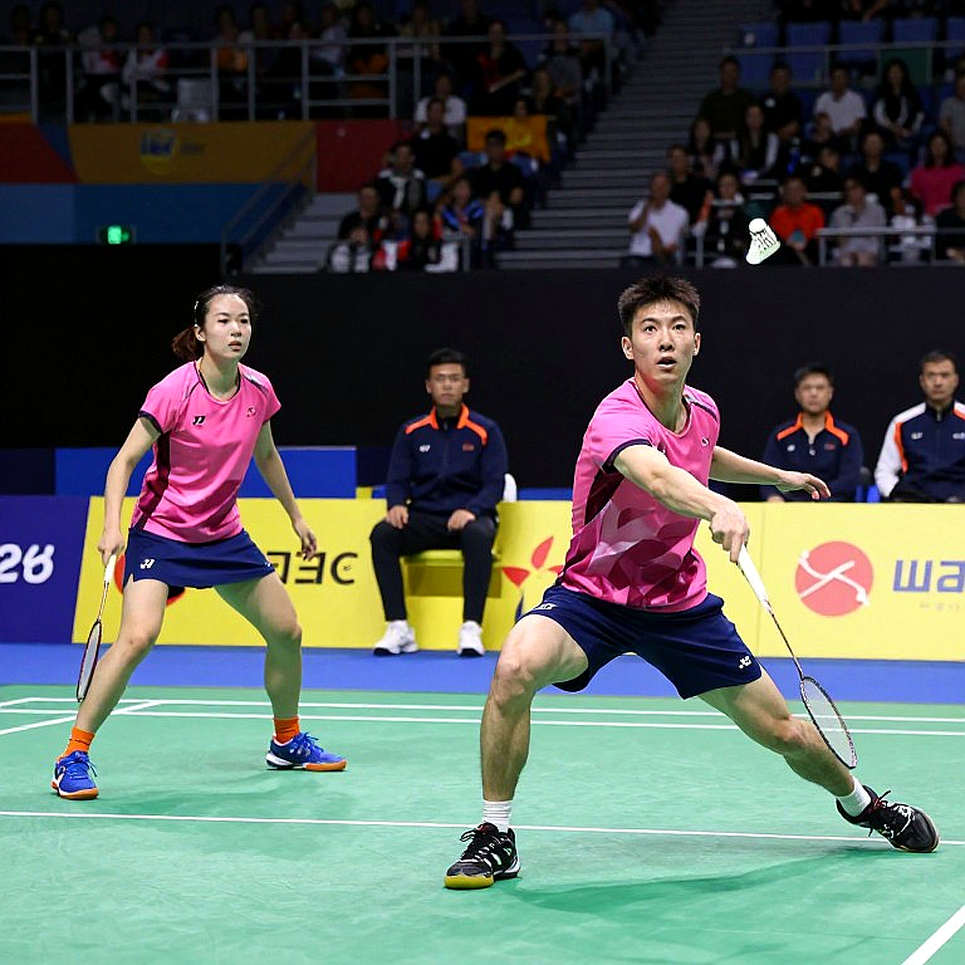
To understand each result, the context the original report leaves vague has to be rebuilt. The Asian Games is not a BWF World Tour event. It is run by the Olympic Council of Asia every four years, where badminton is one of dozens of sports. That produces two structural consequences.
First, in badminton terms, most doubles draws at the Games gather almost the entire Asian elite, and in men's doubles, women's doubles and mixed doubles, the Asian elite is essentially the world elite. European entries disappear, but not a single Asian slot is removed. For a pair like Satwik-Chirag, a first-round exit looks like a catastrophe, but that first round is far tougher than a first round at an ordinary Super event.
Second, on the points side, Asian Games results are typically not counted toward the BWF World Ranking. The ranking cost of this exit is therefore close to zero. What is lost sits elsewhere: in the domestic reward system, in reputation, and in the psychological ledger every athlete keeps. And because no ranking points are at stake, there is no "protect the ranking" logic available; only "win the medal" logic exists.
For Satwik-Chirag, that logic just betrayed them.
Looking at the score sequence, 21-12, then 19-21, then 14-21, what stands out is not the loss but the manner. The game margin decays in a very even downward curve: plus nine, then minus two, then minus seven. The scoreline is front-loaded: the Indian pair burned all their energy and focus in the first game, leaving nothing for the last two.
This is what I call the curve of stamina, as opposed to the curve of tactics. A purely tactical defect leaves a different trace: the trailing side still holds its shape in the decider, still stays within a point or two, perhaps losing 19-21 or 20-22. When the gap widens from two points to seven in the final game, that usually signals something leaking from inside the body, not something read from across the net.
No data on shuttle speed, rally length or unforced-error rate was published. That is an information gap that puts any technical conclusion in brackets. But precisely because there is no data, I fall back on what I have: the structure of the scoreline, and the structure of the schedule.
On the scoreline, one detail matters. The Thai pair won the second game by two points, a fragile margin, then exploded by seven in the third. That shift suggests a tactical adjustment at the interval. The most plausible adjustment for a pair beaten in game one by an attacking style is to flatten the shuttle, deny the opponent a high contact point, and stretch rallies to turn the match into an endurance contest. When an attacking pair meets a pair willing to turn the match into a marathon, the winner is not necessarily the better hitter, but the one with more battery left at the end.
Read that way, this is less the story of a bad pair than of a pair that walked on court with a partly empty tank. And the tank was unlikely to be full, given the calendar. The team events ran earlier in the same week. Satwik-Chirag, as India's first-choice men's doubles pair, almost certainly carried a team-event load. The individual events began 25 September, with no significant gap between the two blocks. This is structural to any multi-sport Games. It differs fundamentally from a World Tour event, where a player can withdraw, take a bye, or arrange the schedule around points. At the Games, team and individual events are locked into one window, and every player who carried a team load pays a fatigue tax.
That tax never shows on the scoreboard. It shows in the legs in the third game, in the decision to let a retrievable shuttle drop.
I once wrote about the Euro 2026 shock, when I viewed every match through the lens of head trauma and realised the deepest dent is usually left not by the decisive blow but by the accumulated ones before it. Football and badminton differ in collision speed but share a principle: the body keeps a full ledger, including what nobody counts.
Another detail sits in the badge. The pair entered as defending champions but were seeded fourth. Those two facts do not technically contradict each other, since seeding follows ranking and entry criteria while title-holder status belongs to the past, but they point in different directions when weighing how large the upset really was. A fourth seeding means that at the draw, they were not considered one of the two best pairs in the world. The upset is real, but it does not by itself prove that a powerhouse has collapsed. It only suggests the gap between the top five and the top forty in men's doubles is narrowing, if read as a signal rather than a verdict.
On the other side of the picture, another Indian pair did what nobody expected at the start of the day. Dhruv Kapila and Tanisha Crasto played two matches and won both without dropping a game. The first was a demolition of a weak pair, a result that says little. The second was the talking point: 22-20 and 24-22 against Malaysia's Goh Soon Huat and Lai Shevon Jemie. Two games, both reaching deuce. At 20-20, the shuttle stops being about technique and becomes about nerve and decision-making.
Winning both deuce games is material evidence of clutch competence, something a demolition of a weak pair can never measure.
While the flagship pair burned everything to win game one and collapsed in the decider, this younger pair did the opposite: they kept their heads until the final two points. That is the kind of signal I always prioritise, because it cannot be faked. A spectacular smash can be luck. A correct decision at 20-20 cannot. But the next point must be said to avoid over-reading. In the quarterfinals their opponent is China's top-seeded pair. That is a sudden jump in difficulty, and the day's brilliance could be swallowed in a single match. One win, however beautiful, is a data point, not a manifesto.
India's remaining pair drew attention not with a shock but with a suspicious evenness. Treesa Jolly and Gayatri Gopichand beat a Hong Kong pair 21-16, 16-21, 21-16. Three games, each ending with a five-point margin in the same pattern. That is what analysts call a non-separating scoreline. They were neither overwhelmed nor able to break away. Against a lower-ranked opponent, holding a frozen five-point gap for three games points to a tempo-control problem. A higher-tier pair usually creates clear separation, either ending the match early or burying the opponent in game three.
All three games ending in the same pattern also suggests the Indian pair ran one template throughout and had no plan B to accelerate. On a day when the flagship pair collapsed from exhaustion, another pair was stuck inside its own tempo. And there is a scheduling detail that makes their next match more worrying. Their next opponent is Japan's Fukushima and Matsumoto, the same pair they had just beaten in the team event within the same week, in straight games. In elite badminton, meeting an opponent you have just beaten, especially one who has now had direct exposure to your patterns, is a subtle disadvantage. The losing side of the previous meeting has more to learn.
But if forced to pick the most valuable information from Day 1, I would not pick the flagship upset. I would pick the two heavy defeats few noticed. India's backup pairs fell by scorelines beyond argument: one match ended 21-9, 21-5; another 21-14, 21-11. This was not losing; this was being swept away. And both defeats came against Indonesia's secondary pairs, players who are only the second or third choices in their system.
This is where the real hole shows: India can produce top pairs, but its system breaks immediately behind the first tier.
If the flagship pair represents the peak of a pyramid, those two heavy defeats represent its body. And the body is showing how thin it is. In a sport where depth decides team-event strength and the ability to rotate athletes through consecutive rounds, a large gap right behind the first pair signals a development problem, not a bad day. This explains why I am less anxious about the Satwik-Chirag result than Indian public opinion. A pair losing in three games at the end of a load-bearing week is a recoverable event. A depth gap takes years and a development strategy to close. What worries me is not today's fall. It is how few can stand back up.
There is a format detail that makes reading today's result dangerous. Single elimination, best of three games to 21, rally scoring. Together those create more randomness than people assume. A tight shuttle at 19-19, a mishit under pressure, a line call right or wrong, any of these can swing a match without a single technical change.
I repeat this whenever I discuss VAR in football, and in badminton it holds even more strongly because no technology intervenes in every rally. "Clear and obvious error" is such a vague concept that it creates a wide judgment space. In badminton, at least, we have the game scores to reason about match structure. And that structure says this was a patterned fall, not an inexplicable accident. So be careful with over-reading. One defeat cannot re-rate a pair. The only thing this sample can support is a concern about decider performance, not a level regression. Between those two conclusions lies a very large distance, and the value of analysis lies in holding that distance.
Now I have to say plainly what most reports are avoiding. The emotional weight of this story sits almost entirely in two words: "defending champions." Those words turn a loss in a fourth-seeded event into a national tragedy. But the champion's badge is a title from the past, not a measure of current strength. At the time of this tournament, the pair was no longer ranked among the top two. Put simply, about a third of the shock is real; the rest is contributed by the badge.
When a deal collapses, do not ask who was wrong; ask who sat in the director's chair. When a match collapses, do not ask the racket; ask the badge.
And nobody manages the badge. It is born from history, grows in fans' memory, and creates pressure without anyone ordering it. A continental champion from four years ago walks on court carrying two roles at once: a player of the present and a symbol of the past. When the symbol loses, people do not hurt because the player lost. They hurt because the story broke.
I recall my own error at the 2026 World Cup, when I predicted Neymar would leave PSG immediately after the tournament over temporary friction, and I was wrong. I was wrong because I trusted emotion. Years later I understood there is a symmetrical error: being wrong for not trusting. Trusting one result so much that it becomes destiny, and trusting nothing so much that new signals are ignored, both cost the analyst the same currency: credibility.
Pressure on badminton at multi-sport Games has its own character. Audiences are larger, but baseline knowledge is thinner. Media cover it with far higher emotional frequency and intensity than specialist outlets covering an identical World Tour result. That turns a first round into a national story and loads the burden onto players who have not yet played. PV Sindhu, Lakshya Sen, Ayush Shetty, all yet to play, entered via byes, meaning a longer rest window before their campaigns. Their load profile is entirely different from the doubles group. Anyone using the doubles upset to predict anything about men's singles would be making a structurally false analogy.
So what is worth tracking next, and where should we pull our hands back from hasty conclusions? Three things.
First, Satwik-Chirag's decider win rate across the next three to five events. If the blown third game recurs at top-tier events, it is a real stamina and clutch problem. If it vanishes once they are properly rested, the Games fatigue tax is the most parsimonious explanation, and the fix is far cheaper than a technical rebuild.
Second, the point margins of India's sub-first-tier pairs against top-20 Asian pairs. If double-digit defeats keep appearing, that is a structural depth problem requiring long-term pipeline investment, not an incident of a single day.
Third, the badge itself. How India's coaching staff and media handle this story over the next few days will reveal whether they are reacting to a player's fall or to the collapse of a story. The second kind of reaction has driven many badminton nations to swap pairs, change coaches, and rebuild, with the bill usually paid across an entire Olympic cycle.
Twelve years at courtside taught me something I keep repeating to myself. After 2026, I stopped believing in badges; I began believing in what the badges try to hide. In Ichinomiya, what is hidden is not a champion's fall. It is a system built on two top pairs and a void behind them. That is the lesson every badminton nation, including rising ones like Vietnam, should read closely: an outstanding pair can generate strength for a day. Only a deep system sustains it across years. And the question I carry out of Day 1 is not who will win the men's doubles at Aichi-Nagoya. It is how many badminton nations own an outstanding pair while forgetting that a whole system must stand behind it.