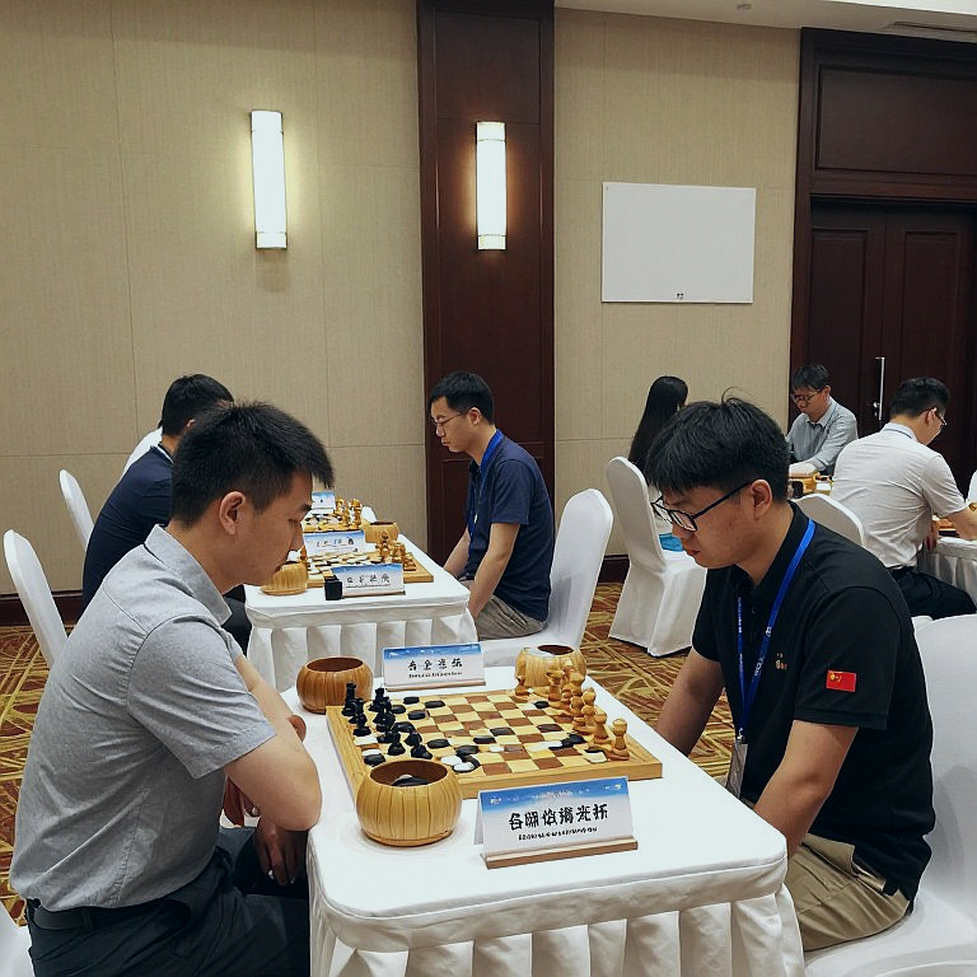
European Club Cup: Beer Sheva's Lone Slip, a Crowded Lead, and a Board One Nobody Has Confirmed
**Câu trả lời cốt lõi** Cúp Câu lạc bộ châu Âu bước vào vòng cuối với nhóm đội đồng dẫn đầu ở cả bảng mở rộng và bảng nữ; Beer Sheva, hạt giống số 10, là đội duy nhất trong nhóm mười hai hạt giống hàng đầu đánh rơi điểm trận sau ba vòng. **Dữ kiện chính** - Beer Sheva (hạt giống số 10) là đội duy nhất trong 12 hạt giống hàng đầu mất điểm trận sau ba vòng. - Vòng 4 bảng mở rộng: SuperChess gặp Bayegan Pendik; bàn 1 dự kiến là Anish Giri đối đầu Nodirbek Abdusattorov. - Bảng nữ: Monte-Carlo gặp Gambit Bonnevoie ở trận quyết định; bản phân tích được ghi nhận ngày 20 tháng 10 năm 2026. - Thể thức: hệ Thụy Sĩ, 4 bàn cộng dự bị, điểm trận 2-1-0, hòa phân định bằng số bàn thắng. - Nguồn có mâu thuẫn nội tại: tiêu đề nêu ba đội đồng dẫn đầu, dữ liệu khác nêu mười một đội đồng hạng nhất. **Nguồn** Bản phân tích chuyên sâu Stage-2 về Cúp Câu lạc bộ châu Âu, ghi ngày 20 tháng 10 năm 2026. **Hỏi đáp liên quan** Hỏi: Đội hạt giống nào trong top 12 đã mất điểm trận? Đáp: Beer Sheva, hạt giống số 10. Hỏi: Bàn 1 vòng 4 có chắc chắn là Giri gặp Abdusattorov? Đáp: Chưa chắc, đó là dự đoán của tác giả vì thứ tự bàn có thể do đội trưởng điều chỉnh. Hỏi: Cúp Câu lạc bộ châu Âu có phải vòng loại Giải vô địch thế giới cá nhân? Đáp: Không, đây là giải đồng đội cấp châu lục nằm ngoài chu trình vòng loại cá nhân.
Beer Sheva, the tenth seed at the European Club Cup, is the only team among the top twelve seeds to have dropped a match point after three rounds. The other eleven are still perfect. That near-total conversion rate says more about this tournament than any beautiful game could: the Elo gap between board three and board four of a big club and the same boards at a mid-table opponent usually lands between 150 and 250 points, enough to settle most matches before the audience even starts waiting for a good move.
The final round closes both sections. In the open section, SuperChess meet Bayegan Pendik. In the women's section, Monte-Carlo meet Gambit Bonnevoie in the match scheduled for Tuesday. Both sections carry a cluster of co-leaders, and that congestion turns the last round into a test of conversion discipline rather than creativity.
The European Club Cup is run by the European Chess Union and gathers clubs from the national league systems of member federations. The format is familiar: a Swiss system, four boards plus reserves per match, 2-1-0 match points, with board count as the tiebreak. Entry comes from domestic league standing, and seeding is ordered by the average rating of the declared squad.
What matters is where the event sits inside professional chess. The European Club Cup lives outside the individual World Championship qualification cycle: no World Cup place, no Grand Swiss, no rating route to the Candidates. What it distributes is a European club title, prize money, and, for many players, appearance fees. Based on my experience following matches at team events, I always place club competitions in the category where money speaks before the board does.
The round report names only four clubs: SuperChess and Bayegan Pendik in the open section, Monte-Carlo and Gambit Bonnevoie in the women's section. The co-leading group is never enumerated, which means the reader cannot reconstruct the standings from the article. For an event whose final round may be decided on board count, that omission is a serious information gap.
So where does technical analysis begin? No games, no opening systems, no ACPL or engine-match figures are cited. Any verdict on the quality of play would be fabrication. The one real technical signal in the data is seeding fidelity: the strong teams are converting almost perfectly, meaning the event is running exactly along budget stratification and lower-board rating gaps.
The core point is this: under 2-1-0 match scoring, captains optimise for winning the match, not for winning individual boards. A club can win the match while losing the board battle, or the reverse. The tactical consequence is clear: board one tends to produce solid, pre-arranged draws in must-not-lose assignments, while boards three and four, where the rating gap is widest, are where teams play most aggressively and most unbalanced. That is a distortion produced by the format, not a signal of strength.
The most discussed pairing is Anish Giri against Nodirbek Abdusattorov on board one. This is a heavyweight clash of styles. Giri, born in 2026, is a positional neutraliser with one of the highest draw rates in elite chess. Abdusattorov, born in 2026, is a dynamic, theory-heavy calculator, strongest in sharp Sicilian and Indian structures and formidable at faster controls. In a classical club match, the practical edge in generating complexity belongs to Abdusattorov; the practical edge in suppressing risk belongs to Giri.
One detail is easy to miss. The report calls this a potential board-one battle, meaning the board order is not locked and can still be adjusted by the captain. At team events, reordering boards in the final round is routine, especially when a team is confident of winning the match without committing its strongest card. The Giri-Abdusattorov pairing is therefore the author's projection, not a confirmed fact.
Preparation depth is another undervalued variable. Club players arrive from different national-team calendars, board order is fixed round by round, and there is no multi-week camp. Opening preparation is therefore structurally thinner than at a Candidates or a World Championship match, and deep theoretical surprises are less likely to be armed.
On the career curve, the age asymmetry favours the younger player. Abdusattorov at 22 sits inside the historic breakthrough window for world champions, while Giri at 32 has entered the plateau of the modern elite curve. The time-control asymmetry also favours Abdusattorov if the club title goes to a faster tiebreak, where he is a former world rapid and blitz champion. Giri's real value in a team match is securing draws with White and holding robustly with Black, a genuine asset under 2-1-0 scoring.
This is where I have to stop and question the source itself. The analysis headline claims three co-leaders in both sections; another data point in the same document claims eleven teams tied for first in the open section after three rounds. Both cannot be true of one standings table. Until the original European Chess Union round report is verified, every standings-dependent conclusion should be read as provisional. For anyone in this trade, an internal contradiction like that matters more than any attractive prediction.
Another trap is the illusion of form. A 2750 player beating a 2450 opponent on board four is entirely rating-consistent; it is not a breakout. Board scores at club events routinely inflate the performance ratings of top-board players, simply because the rating spread across boards is so wide. Reading this event's scoreboard without discounting that structural inflation is self-deception.
The financial picture is worth a look too. Bayegan Pendik, with a name tied to the Pendik district and a corporate title sponsor, shows Turkish capital entering a club base traditionally built on Czech, German, Balkan and Azerbaijani money. At the top of club chess, board one is a rental market: most stars here are paid imports, not products of the clubs that field them. New capital usually brings appearance-fee inflation, and appearance-fee inflation usually brings pressure to show up for the right match.
The women's section is the thinnest-covered part, even though the decisive Monte-Carlo and Gambit Bonnevoie match is where the title is actually awarded. I still remember 2026, sitting down with fifteen women players of a Shanghai football club facing dissolution and hearing them describe selling goods online to survive the pandemic. In 2026 we did not save the club. We saved the belief that the club deserved to exist. In chess the story repeats in another form: women's events still exist, still crown champions, but the audience keeps shrinking. The value of women players is not written on a price sheet; it is written in the fate of girls who dare to dream.
Having spent years looking for the queens missing from the sports map, I see the women's section of the European Club Cup sitting exactly where women's football once sat: present in the standings, absent from memory.
The final round will not be decided by the prettiest game on board one. It will be decided by which captain keeps conversion discipline on boards three and four, who accepts a draw when a draw is needed, and who dares to bet on a lower board instead of protecting a star. The post-2026 generation is arriving on board one of team events with a stubbornness the previous generation did not carry. I have seen a generation ready to press, and I believe they will never step back.